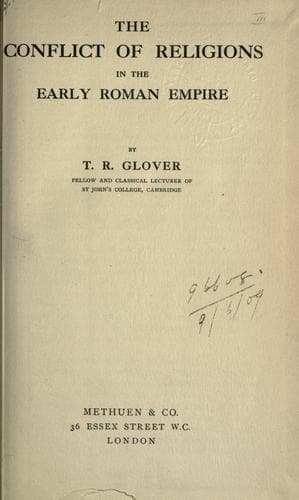
The Conflict of Religions in the Early Roman EmpireGlover, T. R. (Terrot Reaveley)
Religion
The Conflict of Religions in the Early Roman Empire
Glover, T. R. (Terrot Reaveley)
Christianity and other religions; Church history -- Primitive and early church, ca. 30-600; Rome -- Religion
Trypho interjected, "I should like you to know that you are talking
nonsense."[18]
[Sidenote: The problem]
Not unnaturally then did men say to Ignatius (as we have seen), "If I
do not find it in the ancient documents, I do not believe it in the
gospel." And when Ignatius rejoined, "It is written"; "That is the
problem," said they.[19] It was their problem, though it was not his.
For him Judaism is "a leaven old and sour," and "to use the name of
Jesus Christ and yet observe Jewish customs is absurd (_atopon_)" or
really "to confess we have not received grace."[20] His documents were
{175} Jesus Christ, his cross and death and resurrection, and faith
through him.
"That is the problem"--can it be shown from the infallible Hebrew
Scriptures that the crucified Jesus is the Messiah of prophecy, that he
is a "God beside the Creator," that Sabbath and Circumcision are to be
superseded, that Israel's covenant is temporary, and that the larger
outlook of the Christian is after all the eternal dispensation of which
the Jewish was a copy made for a time? If this could be shown, it
might in some measure stop the mouths of hostile Jews, and calm the
uneasy consciences of Jews and proselytes who had become Christians.
And it might serve another and a distinct purpose. It was one of the
difficulties of the Christian that his religion was a new thing in the
world. Around him were men who gloried in ancient literatures and
historic cults. All the support that men can derive from tradition and
authority, or even from the mere fact of having a past behind them, was
wanting to the new faith, as its opponents pointed out. If, by
establishing his contention against the Jew, the Christian could
achieve another end, and could demonstrate to the Greek that he too had
a history and a literature, that his religion was no mere accident of a
day, but was rooted in the past, that it had been foretold by God
himself, and was part of the divine scheme for the destiny of mankind,
then, resting on the sure ground of Providence made plain, he could
call upon the Greek in his turn to forsake his errors and superstitions
for the first of all religions, which should also be the last--the
faith of Jesus Christ.
Public-domain text, read in full here on John Shaqi.
Reviews
Reviews
No reviews yet
Be the first to share your thoughts on this work.
Elsewhere in the archive
Join the Discussion
Join the discussion
Sign in to leave a comment or review.
Sign InorCreate an account