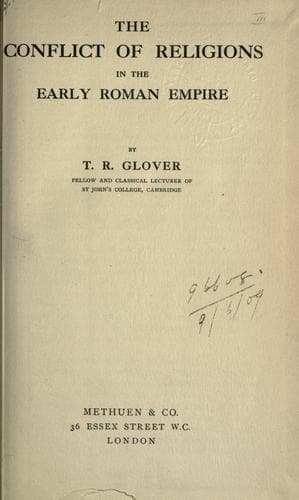
The Conflict of Religions in the Early Roman EmpireGlover, T. R. (Terrot Reaveley)
Religion
The Conflict of Religions in the Early Roman Empire
Glover, T. R. (Terrot Reaveley)
Christianity and other religions; Church history -- Primitive and early church, ca. 30-600; Rome -- Religion
have less {177} skill, and the features of dialogue are sadly whittled
away. Others again abandon all pretence of discussion and frankly
group their matter as a scheme of proof-texts. In what follows, Justin
shall be our chief authority.
We may start with the first point that Trypho raises. "If you will
listen to me (for I count you a friend already), first of all be
circumcised, and then keep, in the traditional way, the Sabbath and the
feasts and new moons of God, and, in a word, do all that is written in
the law, and then perhaps God will have mercy upon you. As for Christ,
if indeed he has been born and already exists, he is unknown--nay! he
does not even know himself yet, nor has he any power, till Elijah come
and anoint him and make him manifest to all men. You people have
accepted an empty tale, and are imagining a Christ for yourselves, and
for the sake of him you are perishing quite aimlessly."[23]
Salvation, according to the Jew, was inconceivable outside the pale of
Judaism. "Except ye be circumcised, ye cannot be saved," men had said
in Paul's time. Paul's repudiation of this assertion is to be read in
his Epistle to the _Galatians_--in his whole life and mind. But genius
such as Paul's was not to be found in the early church, and men looked
outside of themselves for arguments to prove what he had seen and known
of his own experience and insight.
[Sidenote: The letter to Diognetus]
Some apologists merely laughed at the Jew. Thus the brilliant and
winsome writer known only by his _Epistle to Diognetus_ has a short and
ready way of dealing with Jewish usages, which is not conciliatory.
"In the next place I think you wish to hear why Christians do not
worship in the same way as the Jews. Now the Jews do well in
abstaining from the mode of service I have described [paganism], in
that they claim to reverence One God of the universe and count Him
their master; but, in offering this worship to Him in the same way as
those I have mentioned, they go far astray. For the Greeks offer those
things to senseless and deaf images and so give an exhibition of folly,
while the Jews--considering they are presenting them to God as if He
had need of them--ought in all reason to count it foolery and not
piety. For He that made the heaven and the earth and all {178} that is
in them, and gives freely to every one of us what we need, could not
Himself need any of the things which He Himself actually gives to those
who imagine they are giving them to Him....
Public-domain text, read in full here on John Shaqi.
Reviews
Reviews
No reviews yet
Be the first to share your thoughts on this work.
Elsewhere in the archive
Join the Discussion
Join the discussion
Sign in to leave a comment or review.
Sign InorCreate an account