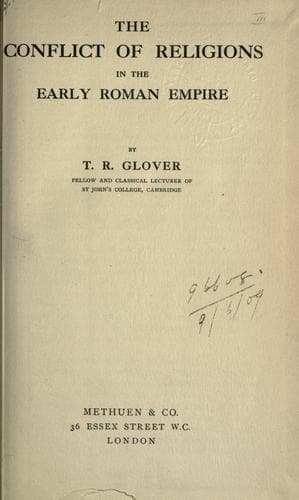
The Conflict of Religions in the Early Roman EmpireGlover, T. R. (Terrot Reaveley)
Religion
The Conflict of Religions in the Early Roman Empire
Glover, T. R. (Terrot Reaveley)
Christianity and other religions; Church history -- Primitive and early church, ca. 30-600; Rome -- Religion
"But again of their nervousness (_psophodees_) about meats, and their
superstition about the Sabbath, and the quackery (_aladoneia_) of
circumcision, and the pretence (_eironeia_) of fasts and new
moons--ridiculous and worthless as it all is, I do not suppose you wish
me to tell you. For to accept some of the things which God has made
for man's need as well created, and to reject others as useless and
superfluous, is it not rebellion (_athemiston_)? To lie against God as
if He forbade us to do good on the Sabbath day, is not that impiety?
To brag that the mutilation of the flesh is a proof of election--as if
God specially loved them for it--ridiculous! And that they should keep
a look-out on the stars and the moon and so observe months and days and
distinguish the ordinances of God and the changes of the seasons, as
their impulses prompt them to make some into feasts and some into times
of mourning--who would count this a mark of piety towards God and not
much rather of folly?
"That Christians are right to keep aloof from the general silliness and
deceit of the Jews, their fussiness and quackery, I think you are well
enough instructed. The mystery of their own piety towards God you must
not expect to be able to learn from man."[24]
This was to deal with the distinctive usages of Judaism on general
principles and from a standpoint outside it. It would doubtless be
convincing enough to men who did not need to be convinced, but of
little weight with those to whom the Scriptures meant everything.
Accordingly the Apologists went to the Scriptures and arrayed their
evidence with spirit and system.
We may begin, as the writer to Diognetus begins, with sacrifices. Here
the Apologists could appeal to the Prophets, who had spoken of
sacrifice in no sparing terms. Tertullian's fifth chapter in his book
_Against the Jews_ presents the evidence shortly and clearly. I will
give the passages cited in a tabular form:--
{179}
_Malachi_ 1, 10: I will not receive sacrifice from your hands, since
from the rising sun to the setting my name is glorified among the
Gentiles, saith the Lord Almighty, and in every place they offer pure
sacrifices to my name.
_Psalm_ 96, 7: Offer to God glory and honour, offer to God the
sacrifices of his name; away with victims (tollite) and enter into his
court.
_Psalm_ 51, 17: A heart contrite and humbled is a sacrifice for God.
_Psalm_ 50, 14: Sacrifice to God the sacrifice of praise and render thy
vows to the Most High.
_Isaiah_ 1, 11: Wherefore to me the multitude of your sacrifices? ....
Whole burnt offerings and your sacrifices and the fat of goats and the
blood of bulls I will not ... Who has sought these from your hands?
Public-domain text, read in full here on John Shaqi.
Reviews
Reviews
No reviews yet
Be the first to share your thoughts on this work.
Elsewhere in the archive
Join the Discussion
Join the discussion
Sign in to leave a comment or review.
Sign InorCreate an account