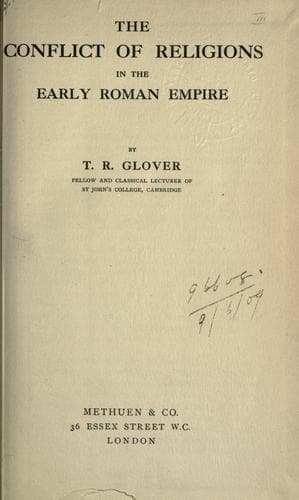
The Conflict of Religions in the Early Roman Empire — John Shaqi
The Conflict of Religions in the Early Roman EmpireGlover, T. R. (Terrot Reaveley)
Religion
The Conflict of Religions in the Early Roman Empire
Glover, T. R. (Terrot Reaveley)
Christianity and other religions; Church history -- Primitive and early church, ca. 30-600; Rome -- Religion
But our theme is religion, and so far we have discussed nothing but
what we may call superstition--and even Plutarch would hardly quarrel
with the name. That to people possessed by such beliefs in non-human
powers, in beings which beset human life with malignity, the
restoration of ancient cult and ritual would commend itself, is only
natural. To such minds the purpose of all worship is to induce the
superhuman being to go peaceably away, and sacrifice implies not human
sin, but divine irritation, which may be irrational. To the religious
temperament, the essential thing is some kind of union, some communion,
with the Divine; and sacrifice becomes the means to effect the relation
of life to a higher will,--to a holier will, we might say, if we allow
to the word "holy" a width of significance more congenial to ancient
than to modern thought. And this higher will implies a divinity of
wider reach than the little gods of primitive superstition, a power
which may even be less personal if only it is great. Religion asks for
the simplification of man's relations with his divine environment, for
escape from the thousand and one petty marauders of the spirit-world
into the empire of some strong and central authority, harsh, perhaps,
or even cruel, but at least a controlling force in man's experience.
If this power is moral, religion is at once fused with morality; if it
is merely physical, religion remains non-moral, and has a constant
tendency to decline into superstition, or at least to make terms with
it.
In the hereditary religion of Rome, the only power that could possibly
have been invested with any such character was Jupiter Capitolinus, but
he had too great a likeness to the other gods of Italy--the gods with
names, that is, for some of the more significant had none--Bona Dea and
Dea Dia for example. Jupiter had his functions, but on the whole they
were local, and there was very little or nothing in him to quicken
thought or imagination. It was not till the Stoics made him more or
less the embodiment of monotheism, that he had a chance of becoming the
centre of a religion in the higher sense of the word, and even then it
was impossible; for first, he was at best little more than an
impersonal dogma, and, secondly, the place was filled by foreign
goddesses of far greater warmth and colour and activity. _Stat magni
nominis umbra_.
{20}
[Sidenote: Cybele and her priests]
It was during the second Punic War that Cybele was brought from Asia
Minor to Rome and definitely established as one of the divinities of
the City.[70] The Great Mother of the gods, she represented the
principle of life and its reproduction, and her worship appealed to
every male and female being in the world. It inspired awe, and it
prompted to joy and merriment; it was imposing and it was mysterious.
Lucretius has a famous description of her pageant:--
Public-domain text, read in full here on John Shaqi.
Reviews
Reviews
No reviews yet
Be the first to share your thoughts on this work.
Join the Discussion
Join the discussion
Sign in to leave a comment or review.
Sign InorCreate an account