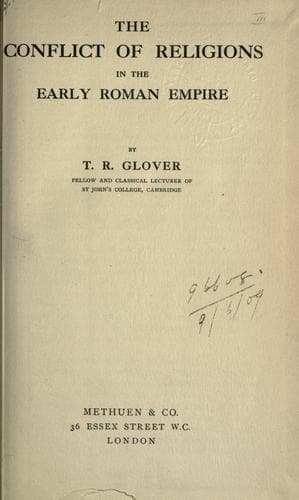
The Conflict of Religions in the Early Roman EmpireGlover, T. R. (Terrot Reaveley)
Religion
The Conflict of Religions in the Early Roman Empire
Glover, T. R. (Terrot Reaveley)
Christianity and other religions; Church history -- Primitive and early church, ca. 30-600; Rome -- Religion
This line of attack was open to the criticism that it robbed the
religious history of Israel of all value whatever, and the stronger
Apologists do not take it. They will allow the Jews to have been so
far right in observing their law, but they insist that it had a higher
sense also, which had been overlooked except by the great prophets.
The law was a series of types and shadows, precious till the substance
came, which the shadows foretold. That they were mere shadows is shown
by the fact that Enoch walked with God and Abraham was the friend of
God. For this could not have been, if the Jewish contention were true
that without Sabbath and circumcision man cannot please God.
Otherwise, either the God of Enoch was not the God of Moses--which was
absurd; or else God had changed his mind as to right and wrong--which
was equally absurd.[38] No, the legislation of Moses was for a people
and for a time; it was not for mankind and eternity. It was a prophecy
of a new legislator, who should repeal the carnal code and enact one
that should be spiritual, final and eternal.[39] Here, following the
writer to the Hebrews, the Apologists quote a great passage of
Jeremiah, with the advantage (not always possible) of using it in the
true sense in which it was written. "Behold! the days come, saith the
Lord, when I will make a new covenant with the house of Israel and with
the house of Judah; not that which I made with their fathers in the day
when I took them by the hand to lead them out of Egypt; which my
covenant they brake, although I was an {182} husband unto them, saith
the Lord. But this shall be the covenant that I will make with the
house of Israel: After those days, saith the Lord, I will put my law in
their inward parts and write it in their hearts, and I will be their
God and they shall be my people."[40]
With the law, the privilege of Israel passes away and the day of the
Gentiles comes. It was foretold that Israel would not accept
Christ--"their ears they have closed";[41] "they have not known nor
understood";[42] "who is blind but my servants?"[43] "all these words
shall be unto you as words of a book that is sealed."[44] "By Isaiah
the prophet, God, knowing beforehand what you would do, cursed you
thus";[45] and Justin cites Isaiah 3, 9-15, and 5, 18-25. Leah is the
type of the synagogue and of the Jewish people and Rachel of "our
church"; the eyes of Leah were weak, and so are the eyes of your
soul--very weak.[46] No less was it prophesied that the Gentiles
should believe on Christ--"in thee shall all tribes of the earth be
blest"; "Behold! I have manifested him as a witness to the nations, a
prince and a ruler to the races. Races which knew thee not shall call
upon thee and peoples who were ignorant of thee shall take refuge with
thee."[47]
Public-domain text, read in full here on John Shaqi.
Reviews
Reviews
No reviews yet
Be the first to share your thoughts on this work.
Elsewhere in the archive
Join the Discussion
Join the discussion
Sign in to leave a comment or review.
Sign InorCreate an account