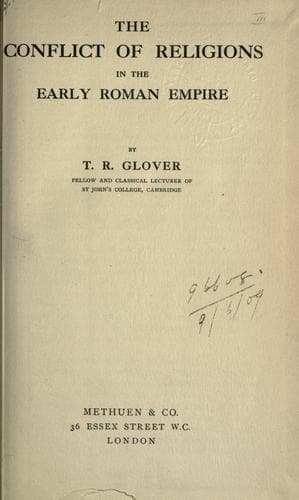
The Conflict of Religions in the Early Roman EmpireGlover, T. R. (Terrot Reaveley)
Religion
The Conflict of Religions in the Early Roman Empire
Glover, T. R. (Terrot Reaveley)
Christianity and other religions; Church history -- Primitive and early church, ca. 30-600; Rome -- Religion
"By David He said 'A people I knew not has served me, and hearkened to
me with the hearing of the ear.' Let us, the Gentiles gathered
together, glorify God," says Justin, "because he has visited us ... for
he is well pleased with the Gentiles, and receives our sacrifices with
more pleasure than yours. What have I to do with circumcision, who
have the testimony of God? What need of that baptism to me, baptized
with the holy spirit? These things, I think, will persuade even the
slow of understanding. For these are not arguments devised by me, nor
tricked out by human skill,--nay! this was the theme of David's lyre,
this the glad news Isaiah brought, that Zechariah proclaimed and Moses
wrote. Do you recognize them, Trypho? They are in your books--no! not
yours, but ours--for we believe them--and you, when you {183} read, do
not understand the mind that is in them."[48] And with that Justin
passes on to discuss whether Jesus is the Messiah. Such a passage
raises the question as to how far he is reporting an actual
conversation. In his 80th chapter he says to Trypho that he will make
a book (_syntaxis_) of their conversation--of the whole of it--to the
best of his ability, faithfully recording all that he concedes to
Trypho. Probably he takes Plato's liberty to develop what was
said--unless indeed the dialogue is from beginning to end merely a
literary form imposed upon a thesis. In that case, it must be owned
that Justin manages to give a considerable suggestion of life to
Trypho's words.
[Sidenote: Jesus the Messiah]
But, even if the law be temporary, and the Sabbath spiritual, if Israel
is to be rejected and the Gentiles chosen, we are still far from being
assured on the warrant of the Old Testament that Jesus is the Messiah,
who shall accomplish this great change. Why he rather than any of the
"ten thousand others" who might much more plausibly be called the
Messiah?[49]
To prove the Messiahship of Jesus, a great system of Old Testament
citations was developed, the origins of which are lost to us. Paul
certainly applied Scripture to Jesus in a free way of his own, though
he is not more fanciful in quotation than his contemporaries. But he
never sought to base the Christian faith on a scheme of texts.
Lactantius, writing about 300 A.D., implies that Jesus is the author of
the system. "He abode forty days with them and interpreted the
Scriptures, which up to that time had been obscure and involved."[50]
Something of the kind is suggested by Luke (24, 27). But it is obvious
that the whole method is quite alien to the mind and style of Jesus, in
spite of quotations in the vein of the apologists which the evangelists
here and there have attributed to him.
Public-domain text, read in full here on John Shaqi.
Reviews
Reviews
No reviews yet
Be the first to share your thoughts on this work.
Elsewhere in the archive
Join the Discussion
Join the discussion
Sign in to leave a comment or review.
Sign InorCreate an account