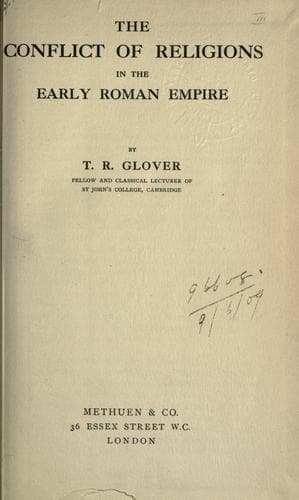
The Conflict of Religions in the Early Roman EmpireGlover, T. R. (Terrot Reaveley)
Religion
The Conflict of Religions in the Early Roman Empire
Glover, T. R. (Terrot Reaveley)
Christianity and other religions; Church history -- Primitive and early church, ca. 30-600; Rome -- Religion
We may discover two great canons in the operations of the Apologists.
In the first place, they seek to show that all things prophesied of the
Messiah were fulfilled in Jesus of Nazareth; and, secondly, that
everything which befel Jesus was prophesied of the Messiah. These
canons need only to be stated to show the sheer impossibility of the
enterprise to {184} anyone who attaches meaning to words. But in the
early centuries of our era there was little disposition with Jew or
Greek to do this where those books were concerned, whose age and beauty
gave them a peculiar hold upon the mind. In each case the
preconception had grown up, as about the myths of Isis, for example,
that such books were in some way sacred and inspired. The theory gave
men an external authority, but it presented some difficulties; for,
both in Homer and in _Genesis_ as in the Egyptian myths, there were
stories repugnant to every idea of the divine nature which a
philosophic mind could entertain. They were explained away by the
allegoric method. Plutarch shows how the grossest features of the Isis
legend have subtle and spiritual meanings and were never meant to be
taken literally--that the myths are _logoi_ in fact; and Philo
vindicates the Old Testament in the same way.[51] The whole procedure
was haphazard and unscientific; it closely resembled the principles
used by Artemidorus for the interpretation of dreams--a painful
analogy. But, in the absence of any kind of historic sense, it was
perhaps the only way in which the continuity of religious thought could
then be maintained. It is not surprising in view of the prevalence of
allegory that the Christians used it--they could hardly do anything
else. Thus with the fatal aid of allegory, the double thesis of the
Apologists became easier and easier to maintain.
The most accessible illustration of this line of apology is to be found
in the second chapter of _Matthew_. We may set out in parallel columns
the events in the life of Jesus and the prophecies which they fulfil.
(a) The Virgin-Birth. _Isaiah_ 7, 14: Behold a virgin
shall conceive.
(b) Bethlehem. _Micah_ 5,2: And thou, Bethlehem,
etc.
(c) The Flight into Egypt. _Hosea_ 11, 1: Out of Egypt
have I called my son.
(d) The Murder of the children. _Jerem._ 31, 15: Rachel weeping.
(e) Nazareth. _Judges_ 13, 5: A Nazarene.
{185} It is hardly unfair to say that the man who cited these passages
in these connexions had no idea whatever of their original meaning,
even where he quotes them correctly.
Here is a fuller scheme taken from the _Apology_ which Justin addressed
to the Emperor Antoninus Pius. (The numbers on the left refer to the
chapter in the first _Apology_.)
Public-domain text, read in full here on John Shaqi.
Reviews
Reviews
No reviews yet
Be the first to share your thoughts on this work.
Elsewhere in the archive
Join the Discussion
Join the discussion
Sign in to leave a comment or review.
Sign InorCreate an account