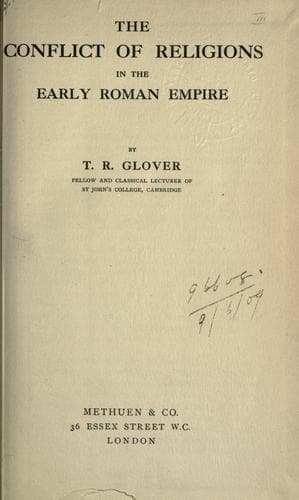
The Conflict of Religions in the Early Roman EmpireGlover, T. R. (Terrot Reaveley)
Religion
The Conflict of Religions in the Early Roman Empire
Glover, T. R. (Terrot Reaveley)
Christianity and other religions; Church history -- Primitive and early church, ca. 30-600; Rome -- Religion
Who then was it who walked in the garden, who wrestled with Jacob, who
appeared in arms to Joshua, who spoke with Moses and with Abraham, who
shut Noah into the ark, who was the fourth figure in the fiery furnace?
Scripture gives us a key. Can the Jew say, who it is whom Ezekiel
calls the "angel of great counsel;" and the "man"; whom Daniel
describes "as the Son of man"; whom Isaiah called "child," and David
"Christ" and "God adored"; whom Moses called "Joseph" and "Jacob" and
"the star"; whom Zechariah called "the daystar"; whom {189} Isaiah
again called the "sufferer" (_pathetos_), "Jacob" and "Israel"; whom
others have named "the Rod," "the Flower," "the Chief Corner-stone" and
"the Son of God"?[58] The answer is more clearly given by Solomon in
the eighth chapter of _Proverbs_--it is the Divine Wisdom, to whom all
these names apply. When it is said "Let _us_ make man," it is to be
understood that the Ineffable communicated his design to his Wisdom,
his Logos or Son, and the Son made man. The Son rained upon Sodom the
fire and brimstone from the Father. It was the Son who appeared to men
in all the many passages cited--the Son, Christ the Lord, God and Son
of God--inseparable and unseverable from the Father, His Wisdom and His
Word and His Might (_dynamis_).[59]
But, while all this might be accepted by a Jew, it still seemed to
Trypho that it was "paradoxical, and foolish, too," to say that Christ
could be God before all the ages, and then tolerate to be born a man,
and yet "not a man of men." The offence of the Cross also remained.
The Apologist began by explaining the mysteries of the two comings of
Christ, first in humiliation, and afterwards in glory, as Jacob
prophesied in his last words.[60] For the First Coming Tertullian
quotes Isaiah--"he is led as a sheep to the slaughter"; and the
_Psalms_--"made a little lower than the angels," "a worm and not a
man"; while the Second Coming is to be read of in Daniel and the
forty-fifth _Psalm_, and in the more awful passage of Zechariah "and
then they shall know him whom they pierced."[61] The paschal lamb is a
type of the First Coming--especially as it was to be roasted whole and
trussed like a cross; and the two goats of _Leviticus_ (16) are types
of the two Comings.[62]
Public-domain text, read in full here on John Shaqi.
Reviews
Reviews
No reviews yet
Be the first to share your thoughts on this work.
Elsewhere in the archive
Join the Discussion
Join the discussion
Sign in to leave a comment or review.
Sign InorCreate an account