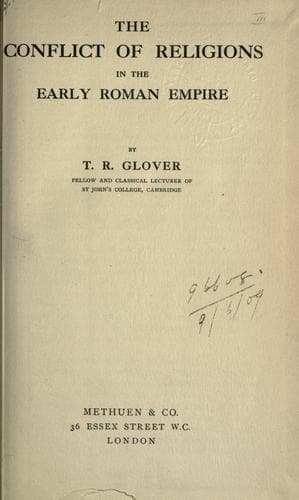
The Conflict of Religions in the Early Roman EmpireGlover, T. R. (Terrot Reaveley)
Religion
The Conflict of Religions in the Early Roman Empire
Glover, T. R. (Terrot Reaveley)
Christianity and other religions; Church history -- Primitive and early church, ca. 30-600; Rome -- Religion
In the absence of any possibility of intellectual certainty, Marcus
fell back upon conduct. Here his want of originality and of spiritual
force was less felt, for conduct has tolerably well-established rules
of neighbourliness, purity, good temper, public duty and the like. His
Stoic guides, too, might in this region help him to follow with more
confidence the voice of his own pure and delicate conscience--the
conscience of a saint and a quietist rather than that of a man of
action. Yet even in the realm of conduct he is on the whole
ineffectual. Pure, truthful, kind, and brave he is, but he does not
believe enough to be great. He is called to be a statesman and an
administrator; he does not expect much outcome from all his energies,
and he preaches to himself the necessity of patience with his
prospective failure to achieve anything beyond the infinitesimal.
"Ever the same are the cycles of the universe, up and down, for ever
and for ever. Either the intelligence of the Whole puts itself in
motion for each separate effect--in which case accept the result it
gives; or else it did so once for all, and everything is sequence, one
thing in another ... [The text is doubtful for a line] ... In a word,
either God, and all goes well; or all at random--live not thou at
random.
"A moment, and earth will cover us all; then it too in its turn will
change; and what it changes to, will change again {199} and again for
ever; and again change after change to infinity. The waves of change
and transformation--if a man think of them and of their speed, he will
despise everything mortal.
"The universal cause is like a winter torrent; it carries all before
it. How cheap then these poor statesmen, these who carry philosophy
into practical affairs, as they fancy--poor diminutive creatures.
Drivellers. Man, what then? Do what now Nature demands. Start, if it
be given thee, and look not round to see if any will know. Hope not
for Plato's Republic;[5] but be content if the smallest thing advance;
to compass that one issue count no little feat.
"Who shall change one of their dogmata [the regular word of Epictetus]?
And without a change of dogmata, what is there but the slavery of men
groaning and pretending to obey? Go now, and talk of Alexander, and
Philip and Demetrius of Phalerum; whether they saw the will of Nature
and schooled themselves, is their affair; if they played the tragic
actor, no one has condemned me to copy them. Simplicity and modesty
are the work of philosophy; do not lead me astray into vanity.
Public-domain text, read in full here on John Shaqi.
Reviews
Reviews
No reviews yet
Be the first to share your thoughts on this work.
Elsewhere in the archive
Join the Discussion
Join the discussion
Sign in to leave a comment or review.
Sign InorCreate an account