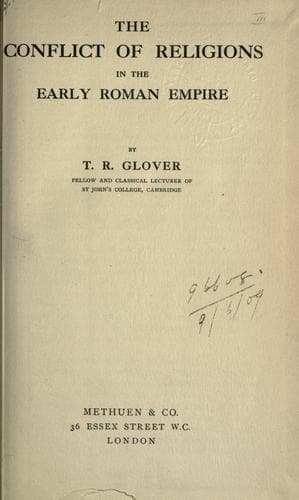
The Conflict of Religions in the Early Roman EmpireGlover, T. R. (Terrot Reaveley)
Religion
The Conflict of Religions in the Early Roman Empire
Glover, T. R. (Terrot Reaveley)
Christianity and other religions; Church history -- Primitive and early church, ca. 30-600; Rome -- Religion
It happens that, while the historical literature of the period has
largely perished, a number of authors survive, who from their various
points of view deal with what is our most immediate subject--the
conflict of religions. Faith, doubt, irritation and fatalism are all
represented. The most conspicuous men of letters of the age are
undoubtedly the Emperor Marcus Aurelius himself and his two brilliant
contemporaries, Lucian of Samosata, and Apuleius of Madaura.[2]
Celsus, a man of mind as powerful as any of the three, survives in
fragments, but fragments ample enough to permit of re-construction.
Among the Christians too there was increased literary activity, but
Tertullian and Clement will suffice for our purpose.
Though not in his day regarded as a man of letters, it is yet in virtue
of his writing that Marcus Aurelius survives. His journal, with the
title that tells its nature--"To Himself," is to-day perhaps the most
popular book of antiquity with those whose first concern is not
literature. It is translated again and again, and it is studied. The
peculiar mind of the solitary Emperor has made him, as Mr F. W. H.
Myers put it, "the saint and exemplar of Agnosticism." Meditative,
tender and candid, yet hesitant and so far ineffectual, he is sensitive
to so much that is positive and to so much that is negative, that the
diary, in which his character is most intimately revealed, gives him a
place of his own in the hearts of men perplext in the extreme. He is a
man who neither believes, nor disbelieves,--"either gods or atoms"[3]
seems to be the necessary antithesis, and there is so much to be said
both for {198} and against each of the alternatives that decision is
impossible. He is attracted by the conception of Providence, but he
hesitates to commit himself. There are arguments--at least of the kind
that rest on probability--in favour of immortality, but they are
insufficient to determine the matter. In his public capacity he became
famous for the number and magnificence of his sacrifices to the gods of
the state; he owns in his journal his debt to the gods for warnings
given in dreams, but he suspects at times that they may not exist.
Meanwhile he persecutes the Christians for their disloyalty to the
state. Their stubborn convictions were so markedly in contrast with
his own wavering mind that he could not understand them--perhaps their
motive was bravado, he thought; they were too theatrical altogether;
their pose recalled the tragedies composed by the pupils of the
rhetoricians--large language with nothing behind it.[4]
Public-domain text, read in full here on John Shaqi.
Reviews
Reviews
No reviews yet
Be the first to share your thoughts on this work.
Elsewhere in the archive
Join the Discussion
Join the discussion
Sign in to leave a comment or review.
Sign InorCreate an account