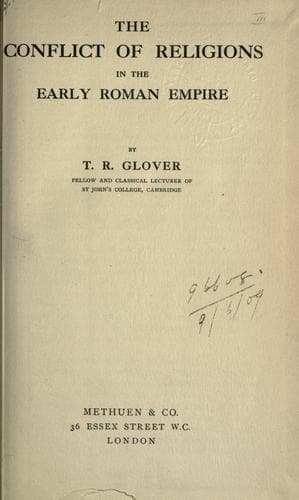
The Conflict of Religions in the Early Roman EmpireGlover, T. R. (Terrot Reaveley)
Religion
The Conflict of Religions in the Early Roman Empire
Glover, T. R. (Terrot Reaveley)
Christianity and other religions; Church history -- Primitive and early church, ca. 30-600; Rome -- Religion
Nor was the personal religion of this pure and candid spirit a possible
one for mankind. "A genuine eternal Gospel," wrote Renan of this diary
of Marcus, "the book of the _Thoughts_ will never grow old, for it
affirms no dogma. The Gospel has grown old in certain parts; Science
no longer allows us to admit the naive conception of the supernatural
which is its base.... Yet Science might destroy God and the soul, and
the book of the _Thoughts_ would remain young in its life and truth."
{201} Renan is right; when Science, or anything else, "destroys God and
the soul," there is no Gospel but that of Marcus; and yet for men it is
impossible; and it is not young--it is senile. Duty without
enthusiasm, hope or belief--belief in man, of course, for "God and the
soul" are by hypothesis "destroyed"--duty, that is, without object,
reason or result, it is a magnificent fancy, and yet one recurs to the
criticism that Marcus passed upon the Christians. Is there not a hint
of the school about this? Is it not possible that the simpler
instincts of men,--instincts with a history as ludicrous as
Anthropologists sometimes sketch for us,--may after all come nearer the
truth of things than semi-Stoic reflexion? At all events the instincts
have ruled the world so far with the co-operation of Reason, and are as
yet little inclined to yield their rights to their colleague. They
have never done so without disaster.
The world did not accept Marcus as a teacher. Men readily recognized
his high character, but for a thousand years and more nobody dreamed of
taking him as a guide--nobody, that is, outside the schools. For the
world it was faith or unbelief, and the two contemporaries already
mentioned represent the two poles to which the thoughts of men
gravitated, who were not yet ready for a cleavage with the past.
[Sidenote: Lucian]
Public-domain text, read in full here on John Shaqi.
Reviews
Reviews
No reviews yet
Be the first to share your thoughts on this work.
Elsewhere in the archive
Join the Discussion
Join the discussion
Sign in to leave a comment or review.
Sign InorCreate an account