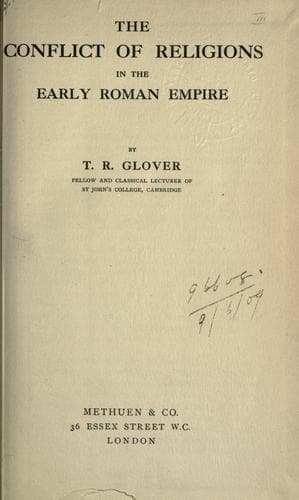
The Conflict of Religions in the Early Roman EmpireGlover, T. R. (Terrot Reaveley)
Religion
The Conflict of Religions in the Early Roman Empire
Glover, T. R. (Terrot Reaveley)
Christianity and other religions; Church history -- Primitive and early church, ca. 30-600; Rome -- Religion
The other point to notice is the picture of Virtue under the image of a
Celestial City, and here one cannot help wondering whether the irony
has any element of personal reminiscence. Virtue Lykinos pictures as a
City, whose citizens are happy, wise and good, little short of gods, as
the Stoics say. All there is peace, unity, liberty, equality. The
citizens are all aliens and foreigners, not a native among
them--barbarians, slaves, misformed, dwarfs, poor; for wealth and birth
and beauty are not reckoned there. "In good truth, we {206} should
devote all our efforts to this, and let all else go. We should take no
heed of our native-land, nor of the clinging and weeping of children or
parents, if one has any, but call on them to take the same journey, and
then, if they will not or cannot go with us, shake them off, and march
straight for the city of all bliss, leaving one's coat in their hands,
if they won't let go,--for there is no fear of your being shut out
there, even if you come without a coat." Fifteen years ago an old man
had urged Lykinos to go there with him. "If the city had been near at
hand and plain for all to see, long ago, you may be sure, with never a
doubt I would have gone there, and had my franchise long since. But as
you tell us, it lieth far away"----and there are so many professed
guides and so many roads, that there is no telling whether one is
travelling to Babylon or to Corinth.[22] "So for the future you had
better reconcile yourself to living like an ordinary man, without
fantastic and vain hopes."[23]
Lucian never ceases to banter the philosophers. When he visits the
Islands of the Blest, he remarks that, while Diogenes and the
Epicureans are there, Plato prefers his own Republic and Laws, the
Stoics are away climbing their steep hill of Virtue, and the Academics,
though wishful to come, are still suspending their judgment, uncertain
whether there really is such an island at all and not sure that
Rhadamanthus himself is qualified to give judgment.[24] Diogenes in
the shades, Pan in his grotto, Zeus in heaven, and the common man in
the streets, are unanimous that they have had too much Philosophy
altogether. The philosophers have indeed embarked on an impossible
quest, for they will never find Truth. Once Lucian represents Truth in
person, and his portrait is characteristic. She is pointed out to
him--a female figure, dim and indistinct of complexion; "I do not see
which one you mean," he says, and the answer is, "Don't you see the
unadorned one there, the naked one, ever eluding the sight and slipping
away?"[25]
[Sidenote: Lucian's _Lover of Lies_]
Public-domain text, read in full here on John Shaqi.
Reviews
Reviews
No reviews yet
Be the first to share your thoughts on this work.
Elsewhere in the archive
Join the Discussion
Join the discussion
Sign in to leave a comment or review.
Sign InorCreate an account