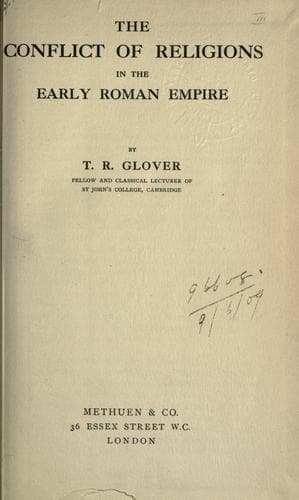
The Conflict of Religions in the Early Roman EmpireGlover, T. R. (Terrot Reaveley)
Religion
The Conflict of Religions in the Early Roman Empire
Glover, T. R. (Terrot Reaveley)
Christianity and other religions; Church history -- Primitive and early church, ca. 30-600; Rome -- Religion
With such a profession, it is not surprising that a man of more wit
than sympathy, found abundance of material in the follies of his age.
Men were taking themselves desperately seriously,--preaching
interminable Philosophy, saving their souls, and communing with gods
and daemons in the most exasperating ways. Shams, impostures, and
liars--so Lucian summed them up, and he did not conceal his opinion.
Granted that the age had aspects quite beyond his comprehension, he
gives a very vivid picture of it from the outside. This is what men
were doing and saying around him--but why? Why, but from vanity and
folly? Gods, philosophers, and all who take human life seriously, are
deluged with one stream of badinage, always clever but not always in
good taste. He has no purpose, religious or philosophic. If he
attacks the gods, it is not as a Sceptic--the Sceptics are ridiculed as
much as any one else in the _Sale of Lives_--men who know nothing,
doubt of their own experience, and avow the end of their knowledge to
be ignorance.[19] If he is what we nowadays loosely call sceptical, it
is not on philosophic grounds. We should hardly expect him in his
satirical pamphlets really to {205} grapple with the question of
Philosophy, but he seems not to understand in the least why there
should be Philosophy at all. He is master of no single system, though
he has the catch-words of them all at his finger-ends.
His most serious dialogue on Philosophy is the _Hermotimus_. "Lykinos"
meets Hermotimus on his way to a lecture--a man of sixty who for many
years has attended the Stoics. Into their argument we need not go, but
one or two points may be noted. Hermotimus is a disciple, simple and
persevering, who owns that he has not reached the goal of Happiness and
hardly expects to reach it, but he presses bravely on, full of faith in
his teachers. Under the adroit questions of Lykinos, he is forced to
admit that he had chosen the Stoics rather than any other school by
sheer intuition--or because of general notions acquired more or less
unconsciously--like a man buying wine, he knew a good thing when he
tasted it, and looked no further. Yes, says Lykinos, take the first
step and the rest is easy--Philosophy depends on a first
assumption--take the Briareus of the poets with three heads and six
hands, and then work him out,--six eyes, six ears, three voices talking
at once, thirty fingers--you cannot quarrel with the details as they
come; once grant the beginning, and the rest comes flooding in,
irresistible, hardly now susceptible of doubt. So in Philosophy, your
passion, like the longing of a lover, blinded you to the first
assumptions, and the structure followed.[20] "Do not think that I
speak against the Stoics, through any special dislike of the school; my
arguments hold against all the schools."[21] The end is that
Hermotimus abandons all Philosophy for ever--not a very dramatic or
probable end, as Plato and Justin Martyr could have told Lucian.
Public-domain text, read in full here on John Shaqi.
Reviews
Reviews
No reviews yet
Be the first to share your thoughts on this work.
Elsewhere in the archive
Join the Discussion
Join the discussion
Sign in to leave a comment or review.
Sign InorCreate an account