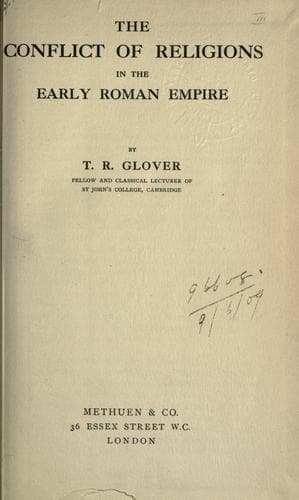
The Conflict of Religions in the Early Roman EmpireGlover, T. R. (Terrot Reaveley)
Religion
The Conflict of Religions in the Early Roman Empire
Glover, T. R. (Terrot Reaveley)
Christianity and other religions; Church history -- Primitive and early church, ca. 30-600; Rome -- Religion
What then does Lucian make of human life? On this he says a great
deal. His most characteristic invention perhaps is the visit that
Charon pays to the upper world to see what it really is that the dead
regret so much. It is indeed, as M. Croiset points out, a fine stroke
of irony to take the opinion of a minister of Death upon Life. Charon
has left his ferry boat and comes up to light. Hermes meets him and
they pile up some mountains--Pelion on Ossa, and Parnassus on top, from
the two summits of which they survey mankind--a charm from Homer
removing Charon's difficulty of vision. He sees many famous people,
such as Milo, Polycrates and Cyrus; and he overhears Croesus and Solon
discussing happiness, while Hermes foretells their fates. He sees a
varied scene, life full of confusion, cities like swarms of bees, where
each has a sting and stings his neighbour, and some, like wasps, harass
and plunder the rest; over them, like a cloud, hang hopes and fears
{214} and follies, pleasures and passions and hatreds. He sees the
Fates spinning slender threads, soon cut, from which men hang with
never a thought of how quickly death ends their dreams; and he compares
them to bubbles, big and little inevitably broken. He would like to
shout to them "to live with Death ever before their eyes"--why be so
earnest about what they can never take away?--but Hermes tells him it
would be useless. He is amazed at the absurdity of their burial rites,
and he astonishes Hermes by quoting Homer on the subject. Last of all
he witnesses a battle and cries out at the folly of it. "Such," he
concludes, "is the life of miserable men--and not a word about
Charon."[45]
Public-domain text, read in full here on John Shaqi.
Reviews
Reviews
No reviews yet
Be the first to share your thoughts on this work.
Elsewhere in the archive
Join the Discussion
Join the discussion
Sign in to leave a comment or review.
Sign InorCreate an account