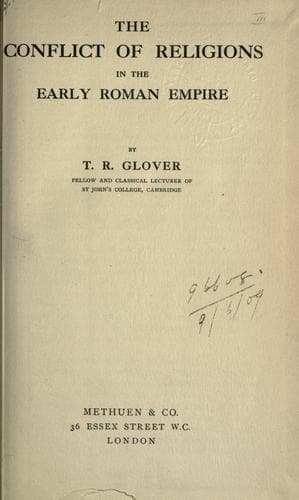
The Conflict of Religions in the Early Roman EmpireGlover, T. R. (Terrot Reaveley)
Religion
The Conflict of Religions in the Early Roman Empire
Glover, T. R. (Terrot Reaveley)
Christianity and other religions; Church history -- Primitive and early church, ca. 30-600; Rome -- Religion
In the same way and in the same spirit Menippus visits the Lower World,
where he sees Minos judging the dead. Minos too seems to have been
interested in literature, for he reduced the sentence upon Dionysius,
the tyrant of Syracuse, on the very proper ground of his generosity to
authors. But the general picture has less humour. "We entered the
Acherusian plain, and there we found the demi-gods, and the heroines,
and the general throng of the dead in nations and tribes, some ancient
and mouldering, 'strengthless heads' as Homer says, others fresh and
holding together--Egyptians these in the main, so thoroughly good is
their embalming. But to know one from another was no easy task; all
become so much alike when the bones are bared; yet with pains and long
scrutiny we began to recognize them. They lay pell-mell in
undistinguishable heaps, with none of their earthly beauties left.
With so many skeletons piled together, all as like as could be, eyes
glaring ghastly and vacant, teeth gleaming bare, I knew not to tell
Thersites from Nireus the fair.... For none of their ancient marks
remained, and their bones were alike, uncertain, unlabelled,
undistinguishable. When I saw all this, the life of man came before me
under the likeness of a great pageant, arranged and marshalled by
Chance," who assigns the parts and reassigns them as she pleases; and
then the pageant ends, every one disrobes and all are alike. "Such is
human life, as it seemed to me while I gazed."[46] Over and over again
with every accent of irony the one moral is enforced--sometimes with
sheer brutality as in the tract on _Mourning_.
{215}
Menippus asked Teiresias in the shades what was the best life. "He was
a blind little old man, and pale, and had a weak voice." He said: "The
life of ordinary people is best, and, wiser; cease from the folly of
metaphysics, of inquiry into origins and purposes; spit upon those
clever syllogisms and count all these things idle talk; and pursue one
end alone, how you may well arrange the present and go on your way with
a laugh for most things and no enthusiasms."[47] In fact, "the
unexamined life" is the only one, as many a weary thinker has felt--if
it were but possible.
[Sidenote: Criticism of Lucian]
Public-domain text, read in full here on John Shaqi.
Reviews
Reviews
No reviews yet
Be the first to share your thoughts on this work.
Elsewhere in the archive
Join the Discussion
Join the discussion
Sign in to leave a comment or review.
Sign InorCreate an account