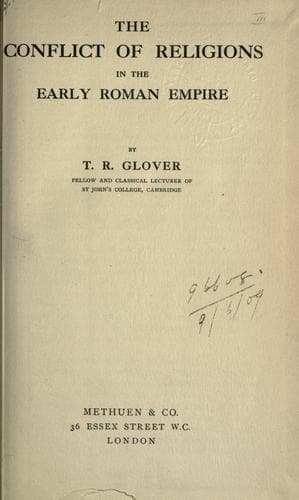
The Conflict of Religions in the Early Roman EmpireGlover, T. R. (Terrot Reaveley)
Religion
The Conflict of Religions in the Early Roman Empire
Glover, T. R. (Terrot Reaveley)
Christianity and other religions; Church history -- Primitive and early church, ca. 30-600; Rome -- Religion
Pausanias mentions several oracles and temples of Apollo in Greece and
Asia Minor--one obscure local manifestation of the god he naturally
enough omitted, but a fellow-citizen of the god preserves it. "It was
in obedience to him, the god of my land, that I undertook this
treatise. He often urged me to it, and in particular appeared visibly
to me (_enargos epiotanti_),[63] since I knew thee, and all but ordered
me to write all this. No wonder that the Daldian Apollo, whom we call
by the ancestral name of Mystes, urged me to this, in care for thy
worth and wisdom, for there is an old friendship between Lydians and
Phoenicians, as they tell us who set forth the legends of the
land."[64] So writes Artemidorus to his friend Cassius Maximus of his
treatise on the scientific interpretation of dreams--a work of which he
is very proud. "Wonder not," he says, "at the title, that the name
stands Artemidorus Daldianus, and not 'of Ephesus,' as on many of the
books I have already written on other subjects. For Ephesus, it
happens, is famous on her own account, and she has many men of note to
proclaim her. But Daldia is a town of Lydia of no great renown, and,
as she has had no such men, she has remained unknown till my day. So I
dedicate this to her, my native-place on the mother's side, as a
parent's due _threpteria_."[65]
Marcus Aurelius records his gratitude "that remedies have been shown to
me by dreams, both others, and against blood-spitting and
giddiness."[66] Plutarch, Pausanias, Aristides--dreams {226} come into
the scheme of things divine with all the devout of our period.
Artemidorus is their humble brother--not the first to give a whole book
to dreams, but proud to be a pioneer in the really scientific treatment
of them--"the accuracy of the judgments, that is the thing for which,
even by itself, I think highly of myself."[67] The critic may take it
"that I too am quite capable of neologisms and persuasive rhetoric
(_ehuresilogein kai pithaneuthai_), but I have not undertaken all this
for theatrical effect or to please the speech-mongers; I appeal
throughout to experience, as canon and witness of my words," and he
begs his readers neither to add to his books nor take anything
away.[68] His writing is, as he says, quite free from "the stage and
tragedy style."
Public-domain text, read in full here on John Shaqi.
Reviews
Reviews
No reviews yet
Be the first to share your thoughts on this work.
Elsewhere in the archive
Join the Discussion
Join the discussion
Sign in to leave a comment or review.
Sign InorCreate an account