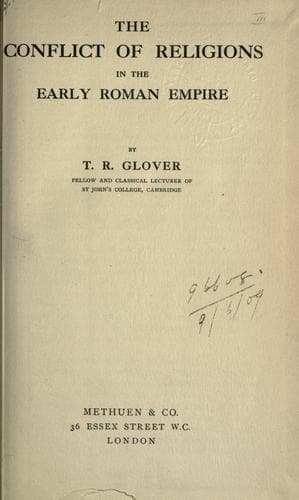
The Conflict of Religions in the Early Roman EmpireGlover, T. R. (Terrot Reaveley)
Religion
The Conflict of Religions in the Early Roman Empire
Glover, T. R. (Terrot Reaveley)
Christianity and other religions; Church history -- Primitive and early church, ca. 30-600; Rome -- Religion
Artemidorus takes himself very seriously. "For one thing, there is no
book on the interpretation of dreams that I have not acquired, for I
had great enthusiasm for this; and, in the next place, though the
prophets (_manteon_) in the market-place are much slandered, and called
beggars and quacks and humbugs by the gentlemen of solemn countenance
and lifted eye-brows, I despised the slander and for many years I have
associated with them--both in Greece, in cities and at festivals, and
in Asia, and in Italy, and in the largest and most populous of the
islands, consenting to hear ancient dreams and their results."[69]
This patient research has resulted in principles of classification.[70]
There are dreams that merely repeat what a man is doing (_enuphnia_);
and others (_oneipoi_) which are prophetic. These last fall into two
classes--theorematic dreams, as when a man dreams of a voyage, and
wakes to go upon a voyage, and allegoric dreams. The latter adjective
has a great history in regions more august, but the allegoric method is
the same everywhere, as an illustration will show. A man dreamed he
saw Charon playing at counters with another man, whom he called away on
business; Charon grew angry and chased him, till he ran for refuge into
an inn called {227} "The Camel," and bolted the door, whereupon "the
daemon" went away, but one of the man's thighs sprouted with grass.
Shortly after this dream he had his thigh broken--the one and sole
event foretold. For Charon and the counters meant death, but Charon
did not catch him, so it was shown that he would not die; but his foot
was threatened, since he was pursued. The name of the inn hinted at
the thigh, because of the anatomy of a camel's thigh; and the grass
meant disuse of the limb, for grass only grows where the earth is left
at rest.[71] The passage is worth remembering whenever we meet the
word allegory and its derivatives in contemporary literature.
Artemidorus has five books of this stuff--the last two dedicated to his
son, and containing instances "that will make you a better interpreter
of dreams than all, or at least inferior to none; but, if published,
they will show you know no more than the rest."[72] The sentence
suggests science declining into profession.
[Sidenote: Apuleius]
Far more brilliant, more amusing and more attractive than any of these
men, whom we have considered since we left Lucian, is Apuleius of
Madaura. Rhetorician, philosopher and man of science, a story-teller
wavering between Boccaccio and Hans Andersen, he is above all a
stylist, a pietist and a humorist. For his history we depend upon
himself, and this involves us in difficulties; for, while autobiography
runs through two of his works, one of these is an elaboration of a
defence he made on a charge of magic and the other is a novel of no
discoverable class but its own, and through both runs a vein of
nonsense, which makes one chary of being too literal.
Public-domain text, read in full here on John Shaqi.
Reviews
Reviews
No reviews yet
Be the first to share your thoughts on this work.
Elsewhere in the archive
Join the Discussion
Join the discussion
Sign in to leave a comment or review.
Sign InorCreate an account