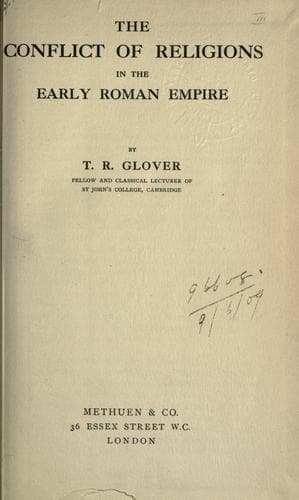
The Conflict of Religions in the Early Roman EmpireGlover, T. R. (Terrot Reaveley)
Religion
The Conflict of Religions in the Early Roman Empire
Glover, T. R. (Terrot Reaveley)
Christianity and other religions; Church history -- Primitive and early church, ca. 30-600; Rome -- Religion
The novel is the _Golden Ass_--that at least is what St Augustine tells
us the author called it.[73] Passages from this have been seriously
used as sources of information as to the author. But there is another
_Ass_, long attributed to Lucian though probably not Lucian's, and in
each case the hero tells the tale in the first person, and the
co-incidences between the Greek and the Latin make it obvious that
there is some {228} literary connexion between them, whatever it is.
The scene is Greece and Thessaly, but not the Greece and Thessaly of
geography, any more than the maritime Bohemia of Shakespeare. Yet in
the last book Apuleius seems to have forgotten "Lucius of Patrae" and to
be giving us experiences of his own which have nothing to do with the
hero of the _Ass_, Greek or Latin.
[Sidenote: The _Apology_ of Apuleius]
In the _Apology_ he comes closer to his own career and he tells us
about himself. Here he does not venture on the delightful assertion
that he is the descendant of the great Plutarch, as the hero of the
_Ass_ does, but avows that, as his native place is on the frontiers of
Numidia and Gaetulia, he calls himself "half Numidian and half
Gaetulian"--just as Cyrus the Greater was "half Mede and half Persian."
His city is "a most splendid colony," and his father held in turn all
its magistracies, and he hopes not to be unworthy of him.[74] He and
his brother inherited two million sesterces, though he has lessened his
share "by distant travel and long studies and constant
liberalities."[75] Elsewhere he tells us definitely that he was
educated at Athens.[76] Everybody goes to the _litterator_ for his
rudiments, to the grammarian next and then to the rhetorician--"but I
drank from other vessels at Athens," so "Empedocles frames songs, Plato
dialogues, Socrates hymns, Epicharmus measures, Xenophon histories,
Xenocrates satires; your Apuleius does all these and cultivates the
nine Muses with equal zeal--with more will, that is, than skill."[77]
Public-domain text, read in full here on John Shaqi.
Reviews
Reviews
No reviews yet
Be the first to share your thoughts on this work.
Elsewhere in the archive
Join the Discussion
Join the discussion
Sign in to leave a comment or review.
Sign InorCreate an account