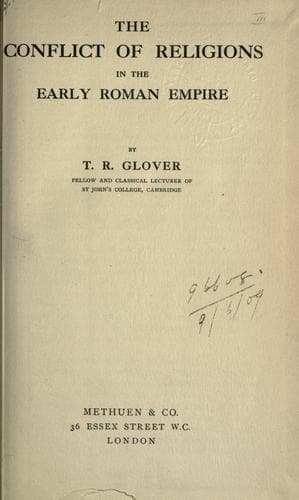
The Conflict of Religions in the Early Roman EmpireGlover, T. R. (Terrot Reaveley)
Religion
The Conflict of Religions in the Early Roman Empire
Glover, T. R. (Terrot Reaveley)
Christianity and other religions; Church history -- Primitive and early church, ca. 30-600; Rome -- Religion
The old and universal fairy-tales of the invisible husband, the cruel
sisters, and the impossible quests are here woven together and brought
into connexion with the Olympic pantheon, and through all runs a slight
thread, only here and there visible, of allegory. But if Psyche is at
times the soul, and if the daughter she bears to Cupid is Pleasure, the
fairy-tale triumphs gloriously over the allegory, and remains the most
wonderful thing of the kind in Latin. Here, and in the _Golden Ass_ in
general, the extraordinarily embroidered language of Apuleius is far
more in keeping than in his philosophic writings. His hundreds of
diminutives and neologisms, his antitheses, alliterations, assonances,
figures and tropes, his brilliant invention, his fun and humour, here
have full scope and add pleasure to every fresh episode of the
fairy-tale and of the larger and more miscellaneous tale of adventure
in which it is set--in the strangest setting conceivable. Cupid and
Psyche is his own addition to the story of the Ass--quite irrelevant,
and like many other irrelevant things in books an immense enrichment.
Another development of the original story which is similarly due to
Apuleius alone is the climax in the last book. The ass, in the Greek
story, becomes a man by eating roses. In the Latin, Lucius, weary of
the life of an ass, finds himself by moonlight on the seashore near
Corinth, and amid "the silent {235} secrets of opaque night," he
reflects that "the supreme goddess rules in transcendent majesty and
governs human affairs by her providence." So he addresses a rather too
eloquent prayer to the Queen of Heaven under her various possible
names, Ceres, Venus, Diana and Proserpine. He then falls asleep, and
at once "lo! from mid sea, uplifting a countenance venerable even to
gods, emerges a divine form. Gradually the vision, gleaming all over,
and shaking off the sea, seemed to stand before me." A crown of
flowers rests on her flowing hair. Glittering stars, the moon, flowers
and fruits, are wrought into her raiment, which shimmers white and
yellow and red as the light falls upon it. In one hand is a sistrum,
in the other a golden vessel shaped like a boat, with an asp for its
handle.[94] She speaks.
[Sidenote: Isis]
Public-domain text, read in full here on John Shaqi.
Reviews
Reviews
No reviews yet
Be the first to share your thoughts on this work.
Elsewhere in the archive
Join the Discussion
Join the discussion
Sign in to leave a comment or review.
Sign InorCreate an account