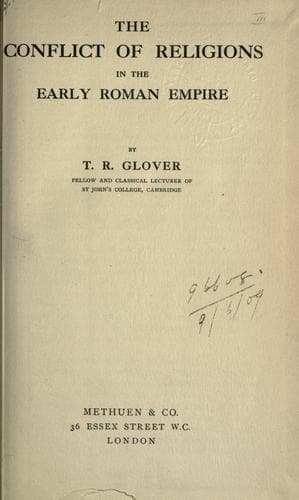
The Conflict of Religions in the Early Roman EmpireGlover, T. R. (Terrot Reaveley)
Religion
The Conflict of Religions in the Early Roman Empire
Glover, T. R. (Terrot Reaveley)
Christianity and other religions; Church history -- Primitive and early church, ca. 30-600; Rome -- Religion
In conclusion, we may ask what Lucian of Samosata and Diogenes of
Oinoanda had to offer to Aristides and Pausanias and Apuleius; and what
they in turn could suggest to men whose concern in religion goes deeper
than the cure of physical disease, trance and self-conscious revelling
in ceremony. Some spiritual value still clung about the old religion,
or it could not have found supporters in a Plotinus and a Porphyry, but
(to quote again a most helpful question) "how much else?"
Chapter VII Footnotes:
[1] On the other hand see a very interesting passage in Tertullian, _de
Anima_, 30, on the progress of the world in civilization, and
population outstripping Nature, while plague, famine, war, etc., are
looked on as _tonsura insolescentis generis humani_.
[2] Marcus Aurelius was born about 121 A.D. and died in 180. The other
two were born in or about 125.
[3] e.g. viii, 17.
[4] The one passage is in xi, 3.
[5] Or, the English equivalent, Utopia.
[6] Marcus Aurelius, ix, 28-40, with omissions. Phrases have been
borrowed from the translations of Mr Long and Dr Rendall.
[7] This sheds some light on his comparison of the Christians to
actors, xi, 3.
[8] Cf. Tertullian, _Apol._ 5, _Hadrianus omnium curiositatum
explorator_.
[9] _Piscator_, 19.
[10] _Quomodo historia_, 24.
[11] _Bis accusatus_, 27.
[12] _Somnium_, 18.
[13] _Bis Accusatus_, 30, 27.
[14] _Apology_, 15.
[15] _Bis Acc._ 32. Cf. Juvenal, 7, 151, _perimit saevos classis
numerosa tyrannos_.
[16] _Bis Acc._ 33, 34.
[17] _Zeus Tragadus_, 15.
[18] _Piscator_, 19, 20.
[19] _Vit. auctio_, 27.
[20] _Hermot._ 74.
[21] _Ibid._ 85.
[22] _Hermot._ 22-28.
[23] _Ibid._ 84.
[24] _V.H._, ii, 18.
[25] _Piscator_, 16.
[26] _Philopseudes_, 7.
[27] _Ibid._ 16.
[28] This ghost appears rather earlier in a letter of Pliny's, vii, 27,
who says he believes the story and adds another of his own.
[29] _Philopseudes_, 34.
[30] _Ibid._ 17.
[31] Pausanias, viii, 29, 3. Cf. Milton's _Ode on Nativity_, 25,
"Typhon huge, ending in snaky twine." References to remains of giants,
in Tertullian, _de resurr. carnis_, 42; Pliny, _N.H._ vii, 16, 73.
[32] _Philopseudes_, 22-24.
[33] _Philopseudes_, 25, 26.
[34] _Icaromenippus_, 24-26.
[35] _Icaromen._ 24.
[36] _Zeus Tragadus_.
[37] _Zeus Elenchomenos_.
[38] _Deor. Eccles._ 14-18.
[39] _Alexander_, 48. The reader of Marcus will remember that his
first book is dated "Among the Quadi."
[40] _Alexander_, 53-56.
[41] Keim, _Celsus' Wahres Wort_, p. 233, suggests that Lucian was not
quite clear as to the differences between Judaism and Christianity.
The reference to forbidden meat lends colour to this.
[42] _De morte Peregrini_, 11, 16; cf. the _Passio Perpetuae_, 3 and 16,
on attention to Christians in prison. Tertullian, _de Jejunio_, 12,
gives an extraordinary account of what might be done for a Christian in
prison, though the case of Pristinus, which he quotes, must have been
unusual, if we are to take all he says as literally true.
Public-domain text, read in full here on John Shaqi.
Reviews
Reviews
No reviews yet
Be the first to share your thoughts on this work.
Elsewhere in the archive
Join the Discussion
Join the discussion
Sign in to leave a comment or review.
Sign InorCreate an account