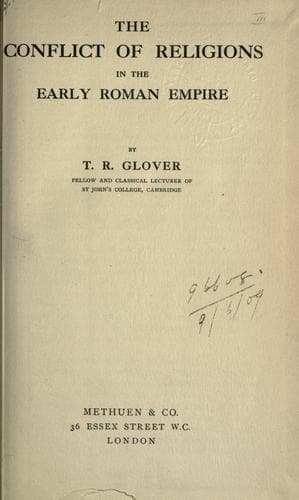
The Conflict of Religions in the Early Roman EmpireGlover, T. R. (Terrot Reaveley)
Religion
The Conflict of Religions in the Early Roman Empire
Glover, T. R. (Terrot Reaveley)
Christianity and other religions; Church history -- Primitive and early church, ca. 30-600; Rome -- Religion
[43] Cf. Tertullian, _ad Martyras_, 4, _Peregrinus qui non olim se rogo
immisit_. Athenagoras, _Presb._ 26, _Proteos, touton d' ouk agnoeite
rhipsanta heauton eis to pur peri ten Olympian_.
[44] Gellius, _N.A._ xii, 11; and summary of viii, 3.
[45] _Charon_ is the title of the dialogue.
[46] _Menippus_, 15, 16.
[47] _Menippus_, 21.
[48] Eckermann, 25th Dec. 1825.
[49] Sextus Empiricus, _Hypotyposes_, i, 25-30.
[50] See _Rheinisches Museum_, 1892, and _Bulletin de Correspondance
Hellenique_, 1897.
[51] C.I.G. iv, 955. Translation of Mary Hamilton, in her
_Incubation_, p. 41 (1906).
[52] I agree with the view of Schubart quoted by J. G. Frazer on the
passage (Pausan. ii, 27, 6) that this man was neither the Emperor
Antoninus Pius nor Marcus. It is perhaps superfluous to call attention
to the value of Dr Frazer's commentary, here and elsewhere.
[53] _Sacred Speech_, ii, Sec. 47, p 301, _litras eikosi kai ekaton_.
[54] _Sacred Speech_, ii, Sec. 33, p. 298. For Aristides see Hamilton,
_Incubation_, pt. i. ch. 3, and Dill, _Roman Society from Nero to
Marcus Aurelius_, bk. iv. ch. 1. See also Richard Caton, M.D., _The
Temples and Ritual of Asklepios_ (1900).
[55] Paus. iii, 15, 11
[56] Paus. viii, 42, 11.
[57] Paus. i, 37, 4; 38, 7.
[58] Paus. x, 4, 4; they smell very like human flesh.
[59] Paus. ix, 40, 11.
[60] Paus. i, 34, 3. Cf. Tertullian, _de Anima_, 46, a list of
dream-oracles. Strabo, c. 761-2, represents the practice as an
essential feature of Judaism, _egkoimasthai de kai autous hyper heauton
kai humer ton allon allous tous euoneipous_; he compares Moses to
Amphiaraus, Trophonius, Orpheus, etc.
[61] Paus. ix, 39, 5-14, Frazer's translation.
[62] Paus. viii, 8, 3 (Frazer). _ton men de es to theion hekonton tois
eireuenois chresometha_.
[63] The word of Luke 2, 9.
[64] Artemidorus Dald. ii, 70.
[65] Artem. Dald. iii, 66.
[66] Marcus, i, 17; George Long's rendering, here as elsewhere somewhat
literal, but valuable as leaving the sharp edges on the thought of the
Greek, which get rubbed off in some translations. See Tertullian, _de
Anima_, cc. 44 and following, for a discussion of dreams, referring to
the five volumes of Hermippus of Berytus for the whole story of them.
[67] Artem. Dald. ii, pref., _mega phrono_.
[68] Artem. Dald. ii, 70. Cf. v. pref., _aneu skenes kai tragosias_.
[69] Artem. Dald. i, pref.
[70] A very different classification in Tertullian, _de Anima_, 47, 48.
Dreams may be due to demons, to God, the nature of the soul or ecstasy.
[71] Artem. Dald. i, 4.
[72] Artem. Dald. iv, pref.
[73] See Augustine, _C.D._ xviii, 18, _Apuleius in libris quos Asini
aurei titulo inscripsit_. In the printed texts, it is generally called
the _Metamorphoses_.
[74] _Apol._ 24.
[75] _Apol._ 23.
[76] _Apol._ 72; _Flor._ 18.
[77] _Flor._ 20.
Public-domain text, read in full here on John Shaqi.
Reviews
Reviews
No reviews yet
Be the first to share your thoughts on this work.
Elsewhere in the archive
Join the Discussion
Join the discussion
Sign in to leave a comment or review.
Sign InorCreate an account