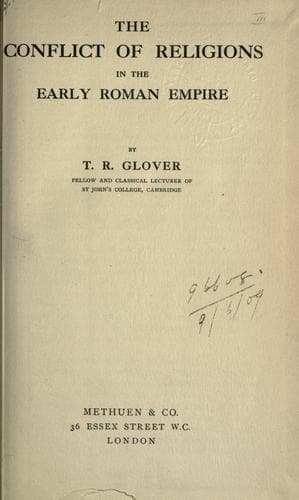
The Conflict of Religions in the Early Roman EmpireGlover, T. R. (Terrot Reaveley)
Religion
The Conflict of Religions in the Early Roman Empire
Glover, T. R. (Terrot Reaveley)
Christianity and other religions; Church history -- Primitive and early church, ca. 30-600; Rome -- Religion
And the absurdity of it! "Why was he not sent to the sinless as well
as to sinners? What harm is there in not having sinned?"[11] Listen
to them! "The unjust, if he humble himself from his iniquity, God will
receive; but the just, if he look up to Him with virtue from beginning
to end, him He will not receive."[12] Celsus' own view is very
different--"It must be clear to everybody, I should think, that those,
who are sinners by nature and training, none could change, {243} not
even by punishment--to say nothing of doing it by pity! For to change
nature completely is very difficult; and those who have not sinned are
better partners in life."[13] Christians in fact make God into a
sentimentalist--"the slave of pity for those who mourn"[14] to the
point of injustice.
[Sidenote: The ecclesia of worms]
Jews and Christians seem to Celsus "like a swarm of bats--or ants
creeping out of their nest--or frogs holding a symposium round a
swamp--or worms in conventicle (_ekklesiaxiousi_) in a corner of the
mud[15]--debating which of them are the more sinful, and saying 'God
reveals all things to us beforehand and gives us warning; he forsakes
the whole universe and the course of the heavenly spheres, and all this
great earth he neglects, to dwell with us alone; to us alone he
despatches heralds, and never ceases to send and to seek how we may
dwell with him for ever.'" "God is," say the worms, "and after him
come we, brought into being by him (_hup' autou gegonotes_), in all
things like unto God; and to us all things are subjected, earth and
water and air and stars; for our sake all things are, and to serve us
they are appointed." "Some of us," continue the worms ("he means us,"
says Origen)--"some of us sin, so God will come, or else he will send
his son, that he may burn up the unrighteous, and that the rest of us
may have eternal life with him."[16]
Public-domain text, read in full here on John Shaqi.
Reviews
Reviews
No reviews yet
Be the first to share your thoughts on this work.
Elsewhere in the archive
Join the Discussion
Join the discussion
Sign in to leave a comment or review.
Sign InorCreate an account