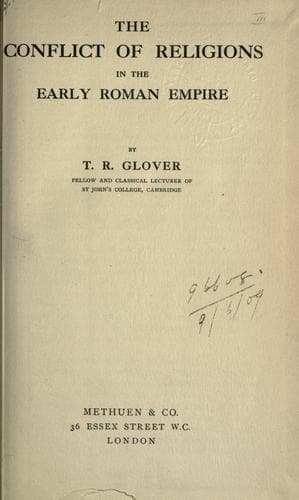
The Conflict of Religions in the Early Roman EmpireGlover, T. R. (Terrot Reaveley)
Religion
The Conflict of Religions in the Early Roman Empire
Glover, T. R. (Terrot Reaveley)
Christianity and other religions; Church history -- Primitive and early church, ca. 30-600; Rome -- Religion
The radical error in Jewish, and Christian thinking is that it is
anthropocentric. They say that God made all things for man,[17] but
this is not at all evident. What we know of the world suggests that it
is not more for the sake of man than of the irrational animals that all
things were made. Plants and trees and grass and thorns--do they grow
for man a whit more than for the wildest animals? "'Sun and night
serve mortals,' says Euripides--but why us more than the ants or the
flies? For them, too, night comes for rest, and day for sight and
work." If men hunt and eat animals, they in their turn hunt and eat
men; and before towns and communities were formed, and tools and
weapons made, man's supremacy was even more questionable. "In no way
is man better in God's {244} sight than ants and bees" (iv. 81). The
political instinct of man is shared by both these creatures--they have
constitutions, cities, wars and victories, and trials at law--as the
drones know. Ants have sense enough to secure their corn stores from
sprouting: they have graveyards; they can tell one another which way to
go--thus they have _logos_ and _ennoiai_ like men. If one looked from
heaven, would there be any marked difference between the procedures of
men and of ants?[18] But man has an intellectual affinity with God;
the human mind conceives thoughts that are essentially divine (_theias
ennoias_).[19] Many animals can make the same claim--"what could one
call more divine than to foreknow and foretell the future? And this
men learn from the other animals and most of all from birds;" and if
this comes from God, "so much nearer divine intercourse do they seem by
nature than we, wiser and more dear to God." Thus "all things were not
made for man, just as they were not made for the lion, nor the eagle,
nor the dolphin, but that the universe as a work of God might be
complete and perfect in every part. It is for this cause that the
proportions of all things are designed, not for one another (except
incidentally) but for the whole. God's care is for the whole, and this
Providence never neglects. The whole does not grow worse, nor does God
periodically turn it to himself. He is not angry on account of men,
just as he is not angry because of monkeys or flies; nor does he
threaten the things, each of which in measure has its portion of
himself."[20]
[Sidenote: The God of the philosophers]
Public-domain text, read in full here on John Shaqi.
Reviews
Reviews
No reviews yet
Be the first to share your thoughts on this work.
Elsewhere in the archive
Join the Discussion
Join the discussion
Sign in to leave a comment or review.
Sign InorCreate an account