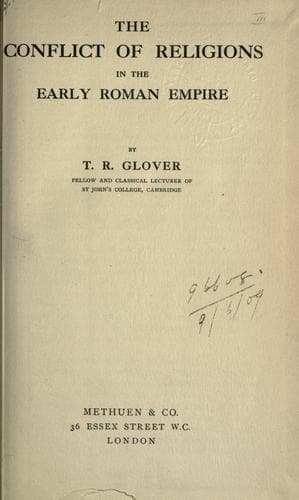
The Conflict of Religions in the Early Roman EmpireGlover, T. R. (Terrot Reaveley)
Religion
The Conflict of Religions in the Early Roman Empire
Glover, T. R. (Terrot Reaveley)
Christianity and other religions; Church history -- Primitive and early church, ca. 30-600; Rome -- Religion
Celsus would seem to have heard Christian preaching, for beside
deriding "Only believe" and "Thy faith will save thee," he is offended
by the language they use about the cross. "Wide as the sects stand
apart, and bitter as are their quarrels and mutual abuse, you will hear
them all say their 'To me the world is crucified and I to the
world.'"[55] In one great passage he mixes, as Origen says, the things
he has mis-heard, and quotes Christian utterances about "a soul that
lives, and a heaven that is slain that it may live, and earth slain
with the {251} sword, and ever so many people being slain to live; and
death taking a rest in the world when the sin of the world dies; and
then a narrow way down, and gates that open of themselves. And
everywhere you have the tree of life and the resurrection of the flesh
from the tree--I suppose, because their teacher was nailed to a cross
and was a carpenter by trade. Exactly as, if he had chanced to be
thrown down a precipice, or pushed into a pit, or choked in a noose, or
if he had been a cobbler, or a stone-mason, or a blacksmith, there
would have been above the heavens a precipice of life, or a pit of
resurrection, or a rope of immortality, or a happy stone, or the iron
of love, or the holy hide."[56]
[Sidenote: The Cross and the miracles]
The miracles of Jesus Celsus easily explains. "Through poverty he went
to Egypt and worked there as a hired labourer; and there he became
acquainted with certain powers [or faculties], on which the Egyptians
pride themselves, and he came back holding his head high on account of
them, and because of them he announced that he was God."[57] But,
granting the miracles of healing and of raising the dead and feeding
the multitudes, he maintains that ordinary quacks will do greater
miracles in the streets for an obol or two, "driving devils out of
men,[58] and blowing away diseases and calling up the souls of heroes,
and displaying sumptuous banquets and tables and sweetmeats and
dainties that are not there;"--"must we count _them_ sons of God?"[59]
There are plenty of prophets too, "and it is quite an easy and ordinary
thing for each of them to say 'I am God--or God's son--or a divine
spirit. And I am come; for already the world perisheth, and ye, oh
men, are lost for your sins. But I am willing to {252} save you; and
ye shall see me hereafter coming with heavenly power. Blessed is he
that has worshipped me now; but upon all the rest I will send eternal
fire, and upon their cities and lands. And men who do not recognize
their own guilt shall repent in vain with groans; and them that have
believed me, I will guard for ever.'"[60] Jesus was, he holds, an
obvious quack and impostor. In fact, there is little to choose between
worshipping Jesus and Antinous, the favourite of Hadrian, who had
actually been deified in Egypt.[61]
Public-domain text, read in full here on John Shaqi.
Reviews
Reviews
No reviews yet
Be the first to share your thoughts on this work.
Elsewhere in the archive
Join the Discussion
Join the discussion
Sign in to leave a comment or review.
Sign InorCreate an account