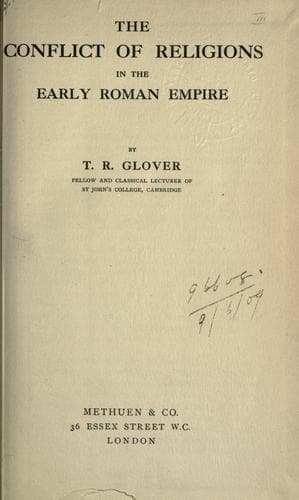
The Conflict of Religions in the Early Roman EmpireGlover, T. R. (Terrot Reaveley)
Religion
The Conflict of Religions in the Early Roman Empire
Glover, T. R. (Terrot Reaveley)
Christianity and other religions; Church history -- Primitive and early church, ca. 30-600; Rome -- Religion
The ignominy of the life of Jesus was evidence to Celsus of the falsity
of his claim to be God's son. He bitterly taunts Christians with
following a child of shame--"God's would not be a body like yours--nor
begotten as you were begotten, Jesus!"[45] He reviles Jesus for the
Passion--"unhelped by his Father and unable to help himself."[46] He
goes to the Gospels ("I know the whole story," he says[47]) and he
cites incident after incident. He reproaches Jesus with seeking to
escape the cross,[48] he brings forward "the men who mocked him and put
the purple robe on him, the crown of thorns, and; {250} the reed in his
hand";[49] he taunts him with being unable to endure his thirst upon
the cross--"which many a common man will endure."[50] As to the
resurrection, "if Jesus wished really to display his divine power, he
ought to have appeared to the actual men who reviled him, and to him
who condemned him and to all, for, of course, he was no longer afraid
of any man, seeing he was dead, and, as you say, God, and was not
originally sent to elude observation."[51] Or, better still, to show
his Godhead, he might have vanished from the gibbet.[52]
What befel Jesus, befals his followers. "Don't you see, my dear sir?"
Celsus says, "a man may stand and blaspheme your daemon; and not that
only, he may forbid him land and sea, and then lay hands on _you_, who
are consecrated to him like a statue, bind you, march you off and
impale you; and the daemon, or, as you say, the son of God, does not
help you."[53] "You may stand and revile the statues of the gods and
laugh. But if you tried it in the actual presence of Dionysus or
Herakles, you might not get off so comfortably. But your god in his
own person they spread out and punished, and those who did it have
suffered nothing.... He too who sent his son (according to you) with
some message or other, looked on and saw him thus cruelly punished, so
that the message perished with him, and though all this time has passed
he has never heeded. What father was ever so unnatural (_anosios_)?
Ah! but perhaps he wished it, you say, and that was why he endured the
insult. And perhaps our gods _wish_ it too, when you blaspheme
them."[54]
Public-domain text, read in full here on John Shaqi.
Reviews
Reviews
No reviews yet
Be the first to share your thoughts on this work.
Elsewhere in the archive
Join the Discussion
Join the discussion
Sign in to leave a comment or review.
Sign InorCreate an account