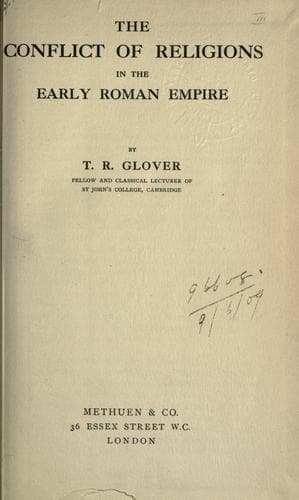
The Conflict of Religions in the Early Roman EmpireGlover, T. R. (Terrot Reaveley)
Religion
The Conflict of Religions in the Early Roman Empire
Glover, T. R. (Terrot Reaveley)
Christianity and other religions; Church history -- Primitive and early church, ca. 30-600; Rome -- Religion
however who speak of the soul or the mind (whether they choose to call
it spiritual, or a spirit intelligent, holy and happy, or a living
soul, or the supercelestial and incorruptible offspring of a divine and
bodyless nature--or whatever they please)--with those who hope to have
this eternally with God, with such I will speak. For they are right in
holding that they who have lived well will be happy and the unjust will
be held in eternal woes. From this opinion (_dogmatos_) let not them
nor any one else depart."[73]
In this way Celsus surveys the main points of Christian history and
teaching. They have no real grounds beneath them. The basis of the
church is "faction (_stasis_) and the profit it brings, and fear of
those without;--those are the things that establish the faith for
them."[74] Faction is their keynote, taken from the Jews at first; and
faction splits them up into innumerable sects beside the "great
church,"[75]--"the {254} one thing they have in common, if indeed they
still have it, is the name; and this one thing they are ashamed to
abandon."[76] When they all say "'Believe, if you wish to be saved, or
else depart'; what are those to do who really wish to be saved? Should
they throw the dice to find out to whom to turn?"[77] In short,
faction is their breath of life, and "if all mankind were willing to be
Christian, then they would not."[78]
[Sidenote: Gods and daemons]
But Celsus is not content merely to refute; he will point out a more
excellent way. "Are not all things ruled according to the will of God?
is not all Providence from him? Whatever there is in the whole scheme
of things, whether the work of God, or of angels, or other daemons, or
heroes, all these have their law from the greatest God; and in power
over each thing is set he that has been counted fit."[79] "Probably
the various sections are allotted to various rulers (_epoptais_) and
distributed in certain provinces, and so governed. Thus among the
various nations things would be done rightly if done as those rulers
would have them. It is then not holy to break down what has been from
the beginning the tradition of one and another place."[80] Again, the
body is the prison of the soul; should there not then be warders of
it--daemons in fact?[81] Then "will not a man, who worships God, be
justified in serving him who has his power from God?"[82] To worship
them all cannot grieve him to whom they all belong.[83] Over and over
Celsus maintains the duty of "living by the ancestral usages," "each
people worshipping its own traditional deities."[84] To say with the
Christians that there is one Lord, meaning God, is to break up the
kingdom of God and make factions there (_stasiaxein_), as if there were
choices to be made, and one were a rival of another.[85]
Public-domain text, read in full here on John Shaqi.
Reviews
Reviews
No reviews yet
Be the first to share your thoughts on this work.
Elsewhere in the archive
Join the Discussion
Join the discussion
Sign in to leave a comment or review.
Sign InorCreate an account