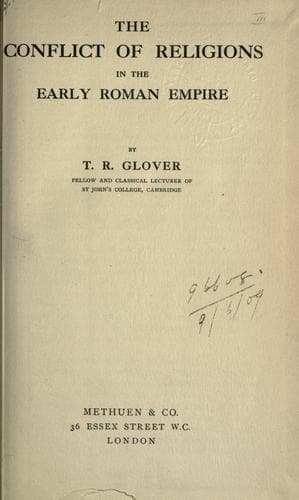
The Conflict of Religions in the Early Roman EmpireGlover, T. R. (Terrot Reaveley)
Religion
The Conflict of Religions in the Early Roman Empire
Glover, T. R. (Terrot Reaveley)
Christianity and other religions; Church history -- Primitive and early church, ca. 30-600; Rome -- Religion
Ammon is no worse than the angels of the Jews; though here the Jews are
so far right in that they hold by the ways of their ancestors--an
advantage which the Jewish proselytes have {255} forfeited.[86] If the
Jews pride themselves on superior knowledge and so hold aloof from
other men, Herodotus is evidence that their supposed peculiar dogma is
shared by the Persians; and "I think it makes no difference whether you
call Zeus the Most High, or Zeus, or Adonai, or Sabaoth, or Amun, like
the Egyptians, or Papaios like the Scythians."[87]
The evidence for the ancillary daemons and gods he finds in the familiar
places. "Why need I tell at length how many things prophets and
prophetesses at the oracles have foretold, and other men and women
possessed by a voice of a god within them? the marvels heard from
shrines? revelations from sacrifices and victims, and other miraculous
tokens? And some have been face to face with visible phantoms. The
whole of life is full of these things." Cities have escaped plague and
famine through warnings from oracles, and have suffered for neglecting
them. The childless have gained children, and the crippled have been
healed, while those who have treated sacred things with contempt have
been punished in suicide and incurable diseases.[88] Let a man go to
the shrine of Trophonius or Amphiaraus or Mopsus, and there he may see
the gods in the likeness of men, no feigned forms (_pseudomenous_) but
clear to see, "not slipping by them once, like him who deceived these
people [the Christians], but ever associating with those who will."[89]
"A great multitude of men, Greeks and barbarians, testify that they
have often seen and still do see Asklepios, and not merely a phantom of
him, but they see himself healing men, and doing them good, and
foretelling the future."[90] Is it not likely that these "satraps and
ministers of air and earth" could do you harm, if you did them
despite?[91] Earthly rulers too deserve worship, since they hold their
positions not without daemonic influence.[92] Why should not the
Christians worship them, daemons and Emperors? If they worshipped no
other but one God, they might have some clear argument against other
men; but, as it is, they more than worship the person who lately
appeared, and reckon that God is not wronged by the service done to his
subordinate,[93]--though in truth he is only a corpse.[94] In any case,
"if idols are nothing, what harm is there in taking part in the
festival? but if there are daemons, it is clear they too {256} are of
God, and in them we must trust, and speak them fair, according to the
laws, and pray that they may be propitious."[95]
Public-domain text, read in full here on John Shaqi.
Reviews
Reviews
No reviews yet
Be the first to share your thoughts on this work.
Elsewhere in the archive
Join the Discussion
Join the discussion
Sign in to leave a comment or review.
Sign InorCreate an account