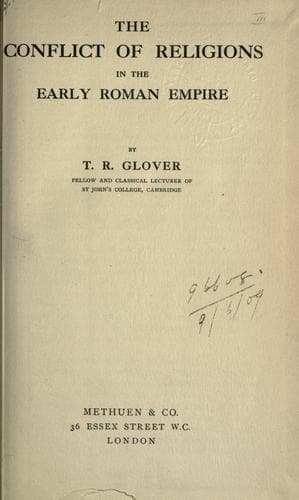
The Conflict of Religions in the Early Roman EmpireGlover, T. R. (Terrot Reaveley)
Religion
The Conflict of Religions in the Early Roman Empire
Glover, T. R. (Terrot Reaveley)
Christianity and other religions; Church history -- Primitive and early church, ca. 30-600; Rome -- Religion
It is not hard to understand this. Though conditions of industry were
not what they are to-day, it is likely that conversion was followed by
the economic results with which we are familiar. The teaching of the
church condemned the vices that war against thrift; and the new life
that filled the convert had its inevitable effect in quickening insight
and energy. The community insisted on every man having a trade and
working at it. With no such end in view, the church must have numbered
among its adherents more and more people of wealth and influence in
spite of all defections, just as to-day Protestantism in France has
power and responsibility out of all proportions to mere numbers. The
Emperor Hadrian, is said to have made the observation that in Egypt,
whether men worshipped Christ or Serapis, they all worshipped money.[1]
The remark had probably as much truth as such sayings generally have,
but we may probably infer that many Christians were punctual in {263}
their observance of the duty laid on them to be "not slothful in
business."
The first four or five generations of Christians could not, on the
whole, boast much culture--so far as their records permit us to judge.
"Not many wise," said Paul, and their fewness has left an impress on
the history of the church. A tendency to flightiness in speculation on
the one hand, and a stolid refusal to speculate at all on the other,
are the marks of second century Christianity. The early attempts made
to come to terms with "human wisdom" were not happy, either at the
centre or on the circumference of the body. The adjustment of the
Gospel story to Old Testament prophecy was not a real triumph of the
human mind, nor were the efforts at scientific theology any better.
Docetism, with its phantom Christ, and Gnosticism with its antithesis
of the just God and the good God, were not likely to satisfy mankind.
Simple people felt that these things struck at their life, and they
rejected them, and began to suspect the intellect. The century saw the
growth of ecclesiastical system, episcopal order and apostolic
tradition. Men began to speak of the "old church," the "original
church" and the "catholic church," and to cleave to its "rule of faith"
and "tradition of sound words." By 200 A.D. the church was no longer a
new thing in the world; it had its own "ancient history" without going
back to Judaism and the old covenant; it had its legends; and it could
now speak like the Greeks of "the old faith of our fathers."
Public-domain text, read in full here on John Shaqi.
Reviews
Reviews
No reviews yet
Be the first to share your thoughts on this work.
Elsewhere in the archive
Join the Discussion
Join the discussion
Sign in to leave a comment or review.
Sign InorCreate an account