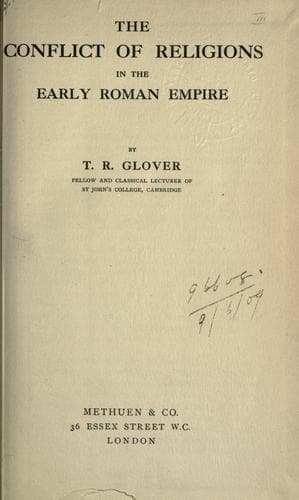
The Conflict of Religions in the Early Roman EmpireGlover, T. R. (Terrot Reaveley)
Religion
The Conflict of Religions in the Early Roman Empire
Glover, T. R. (Terrot Reaveley)
Christianity and other religions; Church history -- Primitive and early church, ca. 30-600; Rome -- Religion
Clement passes from the table to a general discussion of manners and
habits. Man is a "laughing animal," but he should not laugh all the
time. Humour is recommended rather than wit (_charientisteon ou
gelotopoieteon_, 45, 4). "The orderly relaxation of the face which
preserves its harmony" is a smile (46, 3)--giggling and excessive
laughter are perversions. Care should be taken in conversation to
avoid low talk, and the scoff that leads the way to insolence, and the
argument for barren victory--"man is a creature of peace," as the
greeting "Peace with you" shows us. Some talkers are like old
shoes--only the tongue left for mischief. {265} There are many tricks
unfit for a Christian gentleman--spitting, coughing, scratching and
other things; and he would do well to avoid whistling and snapping his
fingers to call the servants. Fidgetting is the mark of mental levity
(_symbolon kouphotetos_).[6]
In the care of one's person, oil may be used; it is a sign of the
luxury of the times that scents and unguents are so universally applied
to such various purposes. The heathen crowned their heads with flowers
and made it a reproach that Christians gave up the practice. But, as
Tertullian said, they smelt with their noses; and Clement urges that on
the head flowers are lost to sight and smell, and chill the brain. A
flower-garden in spring, with the dew upon all its colours, and all the
natural scents of the open air, is another thing. The Christian too
will remember--Tertullian also has this thought--that it was another
crown that the Lord wore[7]--_ex spinis opinor, et tribulis_. The real
objection was that the custom was associated with idol-worship.
Silk and purple and pearls are next dealt with--and earrings, "an
outrage on nature"--if you pierce the ear, why not the nose too?[8]
All peculiarity of dress should be avoided, and so should cosmetics--or
else you may remind people of the Egyptian temple, outside all
splendour, inside a priest singing a hymn to a cat or a crocodile.[9]
"Temperance in drink and symmetry in food are wonderful cosmetics and
quite natural."[10] Let a woman work with her hands, and health will
come and bring her beauty. She should go veiled to church, like AEneas'
wife leaving Troy.[11] Men may play at ball, take country walks, and
try gardening and drawing water and splitting billets.[12]
Finger-rings are allowed for them--gold rings, to be used as seals for
security against the slaves. {266} "Let our seals be a dove, or a
fish, or a ship running before the wind, or a lyre, or a ship's
anchor"--not an idol's face, or a sword or a cup or something
worse.[13] Men should wear their hair short (unless it is curly), grow
their beards and keep their moustaches trimmed with the scissors.[14]
Our slaves we should treat as ourselves, for they are men as we; "God"
(as a verse, perhaps from Menander, puts it) "is the same for all, free
or slave, if you think of it."[15]
Public-domain text, read in full here on John Shaqi.
Reviews
Reviews
No reviews yet
Be the first to share your thoughts on this work.
Elsewhere in the archive
Join the Discussion
Join the discussion
Sign in to leave a comment or review.
Sign InorCreate an account