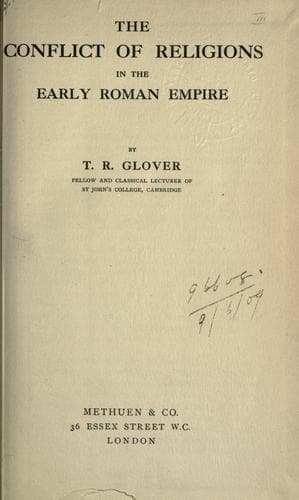
The Conflict of Religions in the Early Roman EmpireGlover, T. R. (Terrot Reaveley)
Religion
The Conflict of Religions in the Early Roman Empire
Glover, T. R. (Terrot Reaveley)
Christianity and other religions; Church history -- Primitive and early church, ca. 30-600; Rome -- Religion
All these admonitions imply an audience with some degree of wealth.
The Christian artisan of Celsus had no temptation to use a silver
foot-bath or to plaster himself with cosmetics. It may also be
remarked that the man who gives the advice shows himself well
acquainted with the ways of good society--and perhaps of society not so
well gifted with taste. With all this refinement went education. The
children of Christian parents were being educated, and new converts
were being made among the cultured classes, and the adjustment of the
new faith and the old culture was imperative. The men to make it were
found in a succession of scholars, learned in all the wisdom of Greece,
enthusiastic for philosophy and yet loyal to the Gospel tradition.
The first of these, whose name we know, was Pantaenus; but beyond his
name there is little to be known of him. Eusebius says that he began
as a Stoic philosopher and ended as a Christian missionary to
India.[16] His pupil, Clement, is of far greater importance in the
history of Christian thought.
[Sidenote: His classical training]
Of Clement again there is little to be learnt beyond what can be
gathered from his own writings. He alludes himself to the death of the
Emperor Commodus as being "194 years, 1 month and 13 days" after the
birth of Christ (it was in 192 A.D.); and Eusebius quotes a passage
from a contemporary letter which shows that Clement was alive in 211
A.D., and another written in or about 215, which implies that he was
dead.[17] We have also an indication from Eusebius that his activity
as a teacher in Alexandria lasted from 180 {267} to 202 or 203.[18] We
may then assume that Clement was born about the middle of the century.
Epiphanius says that Clement was either an Alexandrine or an Athenian.
A phrase to be quoted below suggests that he was not an Alexandrine,
and it has been held possible that he came from Athens.[19] It also
seems that he was born a pagan.[20] Perhaps he says this himself when
he writes: "rejoicing exceedingly and renouncing our old opinions we
grow young again for salvation, singing with the prophecy that chants
'How good is God to Israel.'"[21]
Public-domain text, read in full here on John Shaqi.
Reviews
Reviews
No reviews yet
Be the first to share your thoughts on this work.
Elsewhere in the archive
Join the Discussion
Join the discussion
Sign in to leave a comment or review.
Sign InorCreate an account