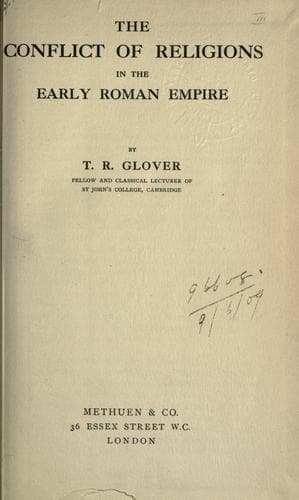
The Conflict of Religions in the Early Roman EmpireGlover, T. R. (Terrot Reaveley)
Religion
The Conflict of Religions in the Early Roman Empire
Glover, T. R. (Terrot Reaveley)
Christianity and other religions; Church history -- Primitive and early church, ca. 30-600; Rome -- Religion
In philosophy his training must have been much the same, but here he
had a more living interest. Philosophy touched him more nearly, for it
bore upon the two great problems of the human soul--conduct and God.
Like Seneca and Plutarch he was not interested in Philosophy apart from
these issues--epistemology, psychology, physics and so forth were not
practical matters. The philosophers he judged by their theology. With
religious men of his day he leant to the Stoics and "truth-loving
Plato"--especially Plato, whom he {269} seems to have read for
himself--but he avows that Philosophy for him means not the system of
any school or thinker, but the sum of the unquestionable dogmata of all
the schools, "all that in every school has been well said, to teach
righteousness with pious knowledge--this eclectic whole I call
Philosophy."[26] To this Philosophy all other studies contribute--they
are "the handmaidens, and she the mistress"[27]--and she herself owns
the sway of Theology.
[Sidenote: Clement and the mysteries]
At some time of his life Clement acquired a close acquaintance with
pagan mythology and its cults. It may be that he was initiated into
mysteries; in his _Protrepticus_ he gives an account of many of them,
which is of great value to the modern student. It is probable enough
that an earnest man in search of God would explore the obvious avenues
to the knowledge he sought--avenues much travelled and loudly vaunted
in his day. Having explored them, it is again not unlikely that a
spirit so pure and gentle should be repelled by rituals and legends
full of obscenity and cruelty. It is of course possible that much of
his knowledge came from books, perhaps after his conversion, for one
great part of Christian polemic was the simple exposure of the secret
rites of paganism. Yet it remains that his language is permanently
charged with technical terms proper to the mysteries, and that he loves
to put Christian knowledge and experience in the old language--"Oh!
mysteries truly holy! Oh! stainless light! The daduchs lead me on to
be the epopt of the heavens and of God; I am initiated and become holy;
the Lord is the hierophant and seals the mystes for himself, himself
the photagogue."[28] It is again a little surprising to hear of "the
Saviour "being" our mystagogue as in the tragedy--
He sees, we see, he gives the holy things (_orgia_);
and if thou wilt inquire
{270}
These holy things--what form have they for thee?
thou wilt hear in reply
Save Bacchus' own initiate, none may know."[29]
It is inconceivable that a Hebrew, or anyone but a Greek, could have
written such a passage with its double series of allusions to Greek
mysteries and to Euripides' _Bacchae_. Clement is the only man who
writes in this way, with an allusiveness beyond Plutarch's, and a fancy
as comprehensive as his charity and his experience of literature and
religion.
Public-domain text, read in full here on John Shaqi.
Reviews
Reviews
No reviews yet
Be the first to share your thoughts on this work.
Elsewhere in the archive
Join the Discussion
Join the discussion
Sign in to leave a comment or review.
Sign InorCreate an account