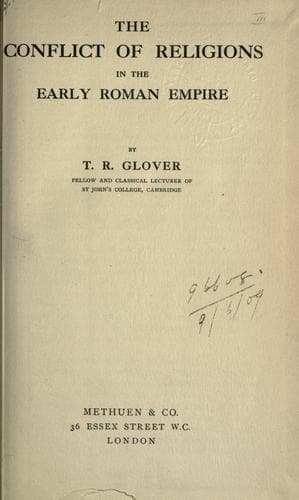
The Conflict of Religions in the Early Roman EmpireGlover, T. R. (Terrot Reaveley)
Religion
The Conflict of Religions in the Early Roman Empire
Glover, T. R. (Terrot Reaveley)
Christianity and other religions; Church history -- Primitive and early church, ca. 30-600; Rome -- Religion
It is obvious that he had the usual training of a Greek of his social
position. If his code of manners is lifted above other such codes by
the constant suggestion of the gentle spirit of Jesus, it yet bears the
mark of his race and of his period. It is Greek and aristocratic, and
it would in the main command the approval of Plutarch. He must have
been taught Rhetoric like every one else,--his style shows this as much
as his protests that he does not aim at eloquence (_euglottia_), that
he has not studied and does not practise "Greek style"
(_helleixein_).[22] He has the diffuse learning of his day--wide,
second-hand and uncritical; and, like other contemporary writers, he
was a devotee of the note-book. No age of Greek literature has left us
so many works of the kind he wrote--the sheer congeries with no attempt
at structure, no "beginning, middle and end,"--easy, accumulative books
of fine miscellaneous feeding, with titles that playfully confess to
their character. Like other authors of this class, Clement preserves
for us many and many a fragment of more interest and value than any
original piece of literature could have been. He clearly loved the
poetry of Greece, and it comes spontaneously and irresistibly to his
mind as he writes, and the sayings of Jesus are reinforced by those of
Menander or Epicharmus. The old words charm him, and {268} he cannot
reject them. His _Stromateis_ are "not like ornamental paradises laid
out in rows to please the eye, but rather resemble some shady and
thickly-wooded hill, where you may find cypress and plane, bay and ivy,
and apple trees along with olives and figs"[23]--trees with literary
connotations. Such works imply some want of the creative instinct, of
originality, and they are an index to the thinking of the age,
impressed with its great ancestry. It is to be remarked that the
writers of our period care little for the literature of the past two or
three centuries; they quote their own teachers and the great
philosophers and poets of ancient Greece.[24] Few of them have any new
thoughts at all, and those who have are under the necessity of clothing
them in the hallowed phrases of their predecessors. This was the
training in which Clement shared. Later on, he emancipated himself,
and spoke contemptuously of the school--"a river of words and a trickle
of mind";[25] but an education is not easily shaken off. He might
quarrel with his teachers and their lessons, but he still believed in
them. It may be noted that in his quotations of Greek literature his
attention is mainly given to the thought which he finds in the
words--or attaches to them--that he does not seem to conceive of a work
of art as a whole, nor does he concern himself with the author. He
used the words as a quotation, and it is not unlikely that many of the
passages he borrowed he knew only as quotations.
Public-domain text, read in full here on John Shaqi.
Reviews
Reviews
No reviews yet
Be the first to share your thoughts on this work.
Elsewhere in the archive
Join the Discussion
Join the discussion
Sign in to leave a comment or review.
Sign InorCreate an account