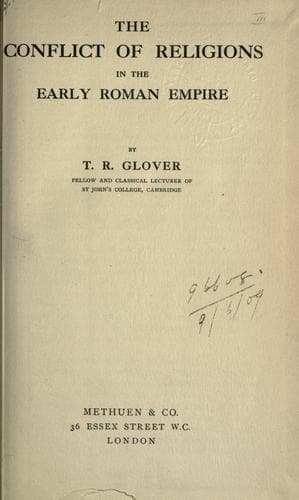
The Conflict of Religions in the Early Roman EmpireGlover, T. R. (Terrot Reaveley)
Religion
The Conflict of Religions in the Early Roman Empire
Glover, T. R. (Terrot Reaveley)
Christianity and other religions; Church history -- Primitive and early church, ca. 30-600; Rome -- Religion
Clement does not tell us that he was born of pagan parents, nor does he
speak definitely of his conversion. It is an inference, and we are
left to conjecture the steps by which it came, but without the help of
evidence. One allusion to his Christian teachers is dropped when he
justifies his writing the _Stromateis_--"memoranda treasured up for my
old age, an antidote against forgetfulness, a mere semblance and
shadow-picture of those bright and living discourses, those men happy
and truly remarkable, whom I was counted worthy to hear." And then the
reading is uncertain, but, according to Dr Stahlin's text he says: "Of
these, one was in Greece--the Ionian; the next (pl.) in Magna Graecia
(one of whom was from Coele Syria and the other from Egypt); others in
the East; and in this region one was an Assyrian, and the other in
Palestine a Hebrew by descent. The last of all (in power he was the
first) I met and found my rest in him, when I had caught him hidden
away in Egypt. He, the true Sicilian bee, culling the flowers of the
prophetic and apostolic meadow, begot pure knowledge in the souls of
those who heard him. These men preserved the true tradition of the
blessed teaching direct from Peter and James, John and Paul, the holy
apostles, son receiving it from father ('and few be sons their fathers'
peers'), and reached down by God's blessing even to us, in us to
deposit those ancestral and apostolic seeds."[35] It is supposed that
the Assyrian was Tatian, while the Sicilian bee hidden away in Egypt
was almost certainly Pantaenus.
Clement's education had been wide and superficial, his reading
sympathetic but not deep, his philosophy vague and eclectic, and now
from paganism with its strange and indefinite aggregation of religions
based on cult and legend, he passed to a faith that rested on a
tradition jealously maintained and a rule beginning to be venerable.
He met men with a definite language in which they expressed a common
experience--who had moreover seen a good many efforts made to mend the
{272} language and all of them ending in "shipwreck concerning the
faith"; who therefore held to the "form of sound words" as the one
foundation for the Christian life.
Public-domain text, read in full here on John Shaqi.
Reviews
Reviews
No reviews yet
Be the first to share your thoughts on this work.
Elsewhere in the archive
Join the Discussion
Join the discussion
Sign in to leave a comment or review.
Sign InorCreate an account