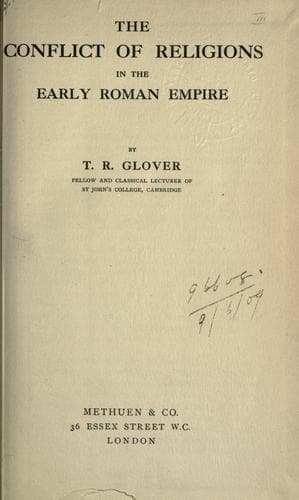
The Conflict of Religions in the Early Roman EmpireGlover, T. R. (Terrot Reaveley)
Religion
The Conflict of Religions in the Early Roman Empire
Glover, T. R. (Terrot Reaveley)
Christianity and other religions; Church history -- Primitive and early church, ca. 30-600; Rome -- Religion
It says a great deal for Clement's character--one might boldly say at
once that it is an index to his personal experience--that he could
sympathize with these men in the warm and generous way he did. Now and
again he is guilty of directing a little irony against the
louder-voiced defenders of "faith only, bare faith"[36] and "straight
opinion"--"the _orthodoxasts_, as they are called."[37] (The curious
word shows that the terms "orthodox" and "orthodoxy" were not yet quite
developed.) But he stands firmly by the simplest Christians and their
experience. If he pleads for a wider view of things--for what he calls
"knowledge," it is, he maintains, the development of the common faith
of all Christians. It is quite different from the wisdom that is
implanted by teaching; it comes by grace. "The foundation of knowledge
is to have no doubts about God, but to believe; Christ is
both--foundation and superstructure alike; by him is the beginning and
the end.... These, I mean faith and love, are not matters of
teaching."[38] As Jesus became perfect by baptism and was hallowed by
the descent of the spirit, "so it befals us also, whose pattern is the
Lord. Baptized, we are enlightened; enlightened, we are made sons;
made sons we are perfected; made perfect we become immortal [all these
verbs and participles are in the present]. 'I,' he saith, 'said ye are
gods and sons of the Most High, all of you.' This work has many names;
it is called gift [or grace, _charisma_], enlightenment, perfection,
baptism.... What is wanting for him who knows God? It would be
strange indeed if that were called a gift of God which was incomplete;
the Perfect will give what is perfect, one supposes.... Thus they that
have once grasped the borders of life are already perfect; we live
already, who are separated from death. Salvation is following
Christ.... So to believe--only to believe--and to be born again is
perfection in life."[39] He praises the poet of {273} Agrigentum for
hymning faith, which his verses declare to be hard; 'and that is why
the Apostle exhorts 'that your faith may not be in the wisdom of
men'--who offer to persuade--'but in the power of God'--which alone and
without proofs can by bare faith save."[40]
[Sidenote: "The real polymetis"]
Public-domain text, read in full here on John Shaqi.
Reviews
Reviews
No reviews yet
Be the first to share your thoughts on this work.
Elsewhere in the archive
Join the Discussion
Join the discussion
Sign in to leave a comment or review.
Sign InorCreate an account