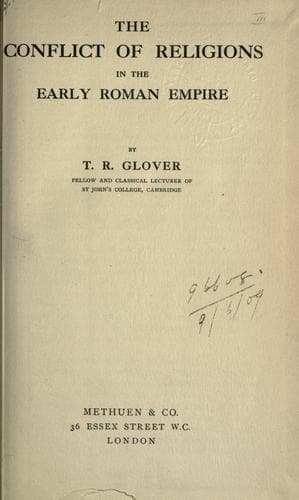
The Conflict of Religions in the Early Roman EmpireGlover, T. R. (Terrot Reaveley)
Religion
The Conflict of Religions in the Early Roman Empire
Glover, T. R. (Terrot Reaveley)
Christianity and other religions; Church history -- Primitive and early church, ca. 30-600; Rome -- Religion
and all the rest that the children of the poets sing."[80] But wrong
conceptions have turned "the heavenly plant, man," from the heavenly
life and laid him low on earth, persuading him to cleave to things
fashioned of earth. So he returns to the discussion of pagan
worships--"but by now your myths too seem to me to have grown old"--and
he speaks of the daemon-theory by which the pagans themselves explained
their religion. The daemons are inhuman and haters of men; they enjoy
the slaying of men--no wonder that with such a beginning superstition
is the source of cruelty and folly. But "no! I must never entrust the
hopes of the soul to things without souls."[81] "The only refuge, it
seems, for him who would come to the gates of "Salvation is the Divine
Wisdom."[82]
{285}
He now reviews the opinions of the philosophers about God. The Stoics
(to omit the rest) "saying that the divine goes through all matter,
even the most dishonourable, shame Philosophy."[83] "Epicurus alone I
will gladly forget."[84] "Where then are we to track out God, Plato?
'The Father and maker of this whole it is hard to find, and, when one
has found him, to declare him to all is impossible.' In his name why?
'For it is unspeakable.' Well said! Plato! thou hast touched the
truth!"[85] "I know thy teachers," still addressing Plato, "Geometry
thou dost learn from Egyptians, Astronomy from Babylonians, the charms
that give health from Thracians; much have the Assyrians taught thee;
but thy laws--such of them as are true--and thy thought of God, to
these thou hast been helped by the Hebrews."[86] After the
philosophers the poets are called upon to give evidence--Euripides in
particular.[87] Finally he turns to the prophets and their message of
salvation--"I could quote you ten thousand passages, of which 'not one
tittle shall pass' without being fulfilled; for the mouth of the Lord,
the holy spirit, spoke them."[88]
Public-domain text, read in full here on John Shaqi.
Reviews
Reviews
No reviews yet
Be the first to share your thoughts on this work.
Elsewhere in the archive
Join the Discussion
Join the discussion
Sign in to leave a comment or review.
Sign InorCreate an account