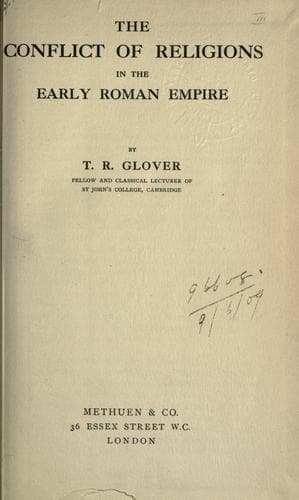
The Conflict of Religions in the Early Roman EmpireGlover, T. R. (Terrot Reaveley)
Religion
The Conflict of Religions in the Early Roman Empire
Glover, T. R. (Terrot Reaveley)
Christianity and other religions; Church history -- Primitive and early church, ca. 30-600; Rome -- Religion
He begins with the famous singers of Greek myth--Amphion, Arion, and
Eunomus with the grass-hopper... You will believe empty myths, he
says, but "Truth's bright face seems to you to be false and falls under
eyes of unbelief." But Cithaeron and Helicon are old. "Let us bring
Truth and shining Wisdom from heaven above to the holy mount of God and
the holy choir of the prophets. Let her, beaming with light that
spreads afar, illumine all about her them that lie in darkness, and
save men from error." "My Eunomus sings not Terpander's strain, nor
Capion's, not the Phrygian, the Lydian or the Dorian, but the eternal
strain of the new harmony, the strain that bears the name of God, the
new song, the song of the Levite, with
A drug infused antidote to the pains
Of grief and anger, a most potent charm
For ills of every name,[76]
a sweet and true cure of sorrow." Orpheus sang to enslave men to
idols, to foolish rites, to shadows. "Not such is my singer; he has
come, soon to end cruel slavery to tyrannic daemons; he transfers us to
the gentle and kindly yoke of piety, and calls to heaven them that were
fallen to earth."[77]
It was this new song that first made the whole cosmos a harmony, and it
is still the stay and harmony of all things. It was this Logos of God
who framed "the little cosmos, man," setting soul and body together by
the holy spirit, and who sings to God upon this organ of many
tones--man. The Logos himself is an organ for God, of all the
harmonies, tuneful and holy.[78] What does this organ, this new song,
tell us?
The Logos, that was before the Day-Star was, has appeared among men as
a teacher,--he by whom all things were made. {284} As Demiurge he gave
life; as teacher he taught to live well; that, as God, he may lavish
upon us life forever. Many voices and many means has the Saviour
employed for the saving of men. Lest you should disbelieve these, the
Logos of God has himself become man that you might learn from man how
man may become God.[79]
He casts a glance over Greek myths and mysteries--cymbals, tambourines,
emblems, legends and uncleanness, the work of men who knew not the God
who truly is, men "without hope and without God in the world." "There
was from of old a certain natural fellowship of men with heaven, hidden
in the darkness of their ignorance, but now on a sudden it has leapt
through the darkness and shines resplendent--even as that said by one
of old,
See'st thou that boundless aether there on high
That laps earth round within its dewy arms?
and again,
O stay of earth, that hast thy seat on earth,
Whoe'er thou art, beyond man's guess to see;
Public-domain text, read in full here on John Shaqi.
Reviews
Reviews
No reviews yet
Be the first to share your thoughts on this work.
Elsewhere in the archive
Join the Discussion
Join the discussion
Sign in to leave a comment or review.
Sign InorCreate an account