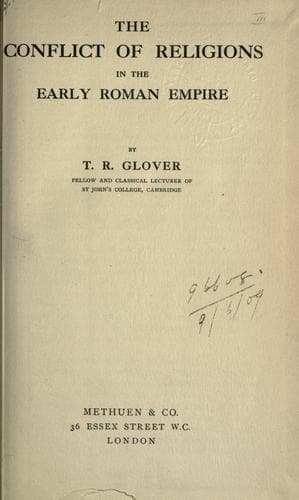
The Conflict of Religions in the Early Roman EmpireGlover, T. R. (Terrot Reaveley)
Religion
The Conflict of Religions in the Early Roman Empire
Glover, T. R. (Terrot Reaveley)
Christianity and other religions; Church history -- Primitive and early church, ca. 30-600; Rome -- Religion
The thoughtful man finds himself, as we have seen, in a polity of gods
and men, a cosmos, well-ordered in its very essence. "In truth," says
Epictetus, "the whole scheme of things (_ta hola_) is badly managed, if
Zeus does not take care of his own citizens, so that they may be like
himself, happy."[88] The first lesson of philosophy is that "there is a
God and that he provides for the whole scheme of things, and that it is
not possible to conceal from him our acts--no, nor our intentions or
thoughts."[89] "God," says Seneca, "has a father's mind towards the
good, and loves them stoutly--'let them,' he says, 'be exercised in
work, pain and loss, that they may gather true strength.'" It is
because God is in love with the good (_bonorum amantissimus_) that he
gives them fortune to wrestle with. "_There_ is a match worth God's
sight (_pardeo dignum_)--a brave man paired with evil
fortune--especially if he is himself the challenger."[90] He goes on to
show that what appear to be evils are not so; that misfortunes are at
once for the advantage of those whom {60} they befall and of men in
general or the universe (_universis_), "for which the gods care more
than for individuals"; that those who receive them are glad to have
them--"and deserve evil if they are not"; that misfortunes come by fate
and befall men by the same law by which they are good. "Always to be
happy and to go through life without a pang of the mind (_sine morsu
animi_) is to know only one half of Nature."[91] "The fates lead us:
what time remains for each of us, the hour of our birth determined.
Cause hangs upon cause.... Of old it was ordained whereat you should
rejoice or weep; and though the lives of individuals seem marked out by
a great variety, the sum total comes to one and the same
thing--perishable ourselves we receive what shall perish."[92] "The
good man's part is then to commit himself to fate--it is a great
comfort to be carried along with the universe. Whatever it is that has
bidden us thus to live and thus to die, by the same necessity it binds
the gods. An onward course that may not be stayed sweeps on human and
divine alike. The very founder and ruler of all things has written
fate, but he follows it: he ever obeys, he once commanded."[93] To the
good, God says, "To you I have given blessings sure and enduring; all
your good I have set within you. Endure! herein you may even
out-distance God; he is outside the endurance of evils and you above
it.[94] Above all I have provided that none may hold you against your
will; the door is open; nothing I have made more easy than to die; and
death is quick."[95]
Public-domain text, read in full here on John Shaqi.
Reviews
Reviews
No reviews yet
Be the first to share your thoughts on this work.
Elsewhere in the archive
Join the Discussion
Join the discussion
Sign in to leave a comment or review.
Sign InorCreate an account