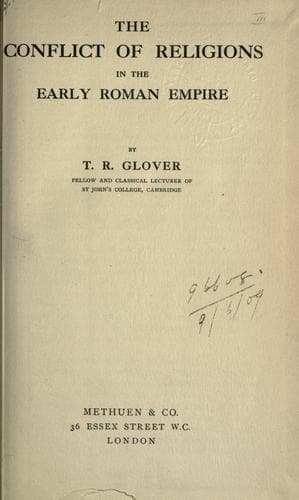
The Conflict of Religions in the Early Roman EmpireGlover, T. R. (Terrot Reaveley)
Religion
The Conflict of Religions in the Early Roman Empire
Glover, T. R. (Terrot Reaveley)
Christianity and other religions; Church history -- Primitive and early church, ca. 30-600; Rome -- Religion
Man's part in life is to be the "spectator and interpreter" of
"God"[101] as he is the "son of God";[102] to attach himself to
God;[103] to be his soldier, obey his signals, wait his call to {62}
retreat; or (in the language of the Olympian festival) to "join with
him in the spectacle and the festival for a short time"
(_sympompeusonta auto kai syneortasonta pros oligon_), to watch the
pomp and the panegyris, and then go away like a grateful and modest
man;[104] to look up to God and say "use me henceforth for what thou
will. I am of thy mind; I am thine."[105] "If we had understanding,
what else ought we to do, but together and severally, hymn God, and
bless him (_euphemein_) and tell of his benefits? Ought we not, in
digging or ploughing or eating, to sing this hymn to God? 'Great is
God who has given us such tools with which to till the earth; great is
God who has given us hands, the power of swallowing, stomachs, the
power to grow unconsciously, and to breathe while we sleep.' ... What
else can I do, a lame old man, but hymn God? If I were a nightingale,
I would do the part of a nightingale ... but I am a rational creature,
and I ought to hymn God; this is my proper work; I do it; nor will I
quit my post so long as it is given me; and you I call upon to join in
this same song."[106] Herakles in all his toils had nothing dearer to
him than God, and "for that reason he was believed to be the son of God
and he was."[107] "Clear away from your thoughts sadness, fear,
desire, envy, avarice, intemperance, etc. But it is not possible to
eject all these things, otherwise than by looking away to God alone
(_pros monon ton theon apobleponta_) by fixing your affections on him
only, by being dedicated to his commands."[108] This is "a peace not of
Caesar's proclamation (for whence could he proclaim it?) but of
God's--through reason."[109]
[Sidenote: Humanity]
The man, who is thus in harmony with the Spermaticos, Logos, who has
"put his 'I' and 'mine'"[110] in the things of the will, has no quarrel
with anything external. He takes a part in the affairs of men without
aggression, greed or meanness. He submits to what is laid upon him.
His peace none can take away, and none can make him angry. There is a
fine passage in Seneca's ninety-fifth letter, following his account of
right worship already quoted, in which he proceeds to deduce from this
the right attitude to men. A sentence or two {63} must suffice. "How
little it is not to injure him, whom you ought to help! Great praise
forsooth, that man should be kind to man! Are we to bid a man to lend
a hand to the shipwrecked, point the way to the wanderer, share bread
with the hungry? ... This fabric which you see, wherein are divine and
human, is one. We are members of a great body. Nature has made us of
one blood, has implanted in us mutual love, has made us for society
(sociabiles). She is the author of justice and equity.... Let that
verse be in your heart and on your lip.
Public-domain text, read in full here on John Shaqi.
Reviews
Reviews
No reviews yet
Be the first to share your thoughts on this work.
Elsewhere in the archive
Join the Discussion
Join the discussion
Sign in to leave a comment or review.
Sign InorCreate an account