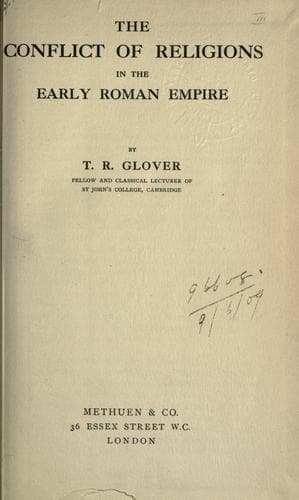
The Conflict of Religions in the Early Roman EmpireGlover, T. R. (Terrot Reaveley)
Religion
The Conflict of Religions in the Early Roman Empire
Glover, T. R. (Terrot Reaveley)
Christianity and other religions; Church history -- Primitive and early church, ca. 30-600; Rome -- Religion
_Homo sum, humani nihil a me alienum puto_"[111]
"Unhappy man! will you ever love? (_ecquando amabis_)" he says to the
irritable.[112] A little before, he said, "Man, a sacred thing to man,
is slain for sport and merriment; naked and unarmed he is led forth;
and the mere death of a man is spectacle enough."[113] This was the
Stoic's condemnation of the gladiatorial shows. Nor was it only by
words that Stoicism worked for humanity, for it was Stoic lawyers who
softened and broadened and humanized Roman law.[114]
Yet Stoicism in Seneca and Epictetus had reached its zenith. From now
onward it declined. Marcus Aurelius, in some ways the most attractive
of all Stoics, was virtually the last. With the second century
Stoicism ceased to be an effective force in occupying and inspiring the
whole mind of men, though it is evident that it still influenced
thinkers. Men studied the Stoics and made fresh copies of their books,
as they did for a thousand years; they borrowed and adapted; but they
were not Stoics. Stoicism had passed away as a system first and then
as a religion; and for this we have to find some reason or reasons.
It may well be true that the environment of the Stoics was not fit for
so high and pure a philosophy. The broad gulf between the common Roman
life and Stoic teaching is evident enough. The intellectual force of
the Roman world moreover was ebbing, and Stoicism required more
strength of mind and character than was easily to be found. That a
religion or a philosophy {64} fails to hold its own is not a sure sign
that it is unfit or untrue; it may only be premature, and it may be
held that at another stage of the world's history Stoicism or some
similar scheme of thought,--or, better perhaps, some central idea round
which a system and a life develop--may yet command the assent of better
men in a better age. At the same time, it is clear that when Stoicism
re-emerges,--if it does,--it will be another thing. Already we have
seen in Wordsworth, and (so far as I understand him) in Hegel, a great
informing conception which seems to have clear affinity with the
Spermaticos Logos of the Stoics. The passage from the "Lines written
above Tintern Abbey" (quoted in the previous chapter) may be
supplemented by many from the "Prelude" and other poems to illustrate
at once the likeness and the difference between the forms the thought
has taken. It is, however, a certain condemnation of a philosophic
school when we have to admit that, whatever its apprehension of truth,
it failed to capture its own generation, either because of some error
of presentment, or of some fundamental misconception. When we find,
moreover, that there is not only a refusal of Stoicism but a reaction
from it, conscious or unconscious, we are forced to inquire into the
cause.
[Sidenote: The individual will]
Public-domain text, read in full here on John Shaqi.
Reviews
Reviews
No reviews yet
Be the first to share your thoughts on this work.
Elsewhere in the archive
Join the Discussion
Join the discussion
Sign in to leave a comment or review.
Sign InorCreate an account