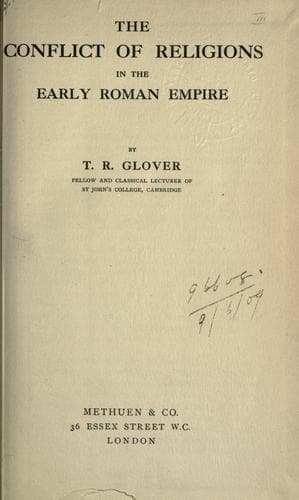
The Conflict of Religions in the Early Roman EmpireGlover, T. R. (Terrot Reaveley)
Religion
The Conflict of Religions in the Early Roman Empire
Glover, T. R. (Terrot Reaveley)
Christianity and other religions; Church history -- Primitive and early church, ca. 30-600; Rome -- Religion
Yet even the individual, much as they strove to exalt his capabilities,
was in the end cheapened in his own eyes.[139] As men have deepened
their self-consciousness, they have yielded to an instinctive craving
for the immortality of the soul.[140] Whether savages feel this or not,
it is needless to argue. No religion apart from Buddhism has
permanently held men which had no hopes of immortality; and how far the
corruptions of Buddhism have modified its rigour for common people, it
is not easy to say. In one form or another, in spite of a terrible
want of evidence, men have clung to eternal life. The Stoics
themselves used this consensus of opinion as evidence for the truth of
the belief.[141] "It pleased me," writes Seneca, "to inquire of the
eternity of souls (_de aeternitate animarum_)--nay! to believe in it. I
surrendered myself to that great hope."[142] {69} "How natural it is!"
he says, "the human mind is a great and generous thing; it will have no
bounds set to it unless they are shared by God."[143] "When the day
shall come, which shall part this mixture of divine and human, here,
where I found it, I will leave my body, myself I will give back to the
gods. Even now I am not without them." He finds in our birth into
this world an analogy of the soul passing into another world, and in
language of beauty and sympathy he pictures the "birthday of the
eternal," the revelation of nature's secrets, a world of light and more
light. "This thought suffers nothing sordid to dwell in the mind,
nothing mean, nothing cruel. It tells us that the gods see all, bids
us win their approval, prepare for them, and set eternity before
us."[144] Beautiful words that wake emotion yet!
[Sidenote: Immortality]
But is it clear that it is eternity after all? In the _Consolation_
which Seneca wrote for Marcia, after speaking of the future life of her
son, he passed at last to the Stoic doctrine of the first
conflagration, and described the destruction of the present scheme of
things that it may begin anew. "Then we also, happy souls who have
been assigned to eternity (_felices animae et aeterna sortitae_), when God
shall see fit to reconstruct the universe, when all things pass
(_labentibus_), we too, a little element in a great catastrophe, shall
be resolved into our ancient elements. Happy is your son, Marcia, who
already knows this."[145] Elsewhere he is still less certain. "Why am
I wasted for desire of him, who is either happy or non-existent? (_qui
aut beatus aut nullus est_)."[146]
Public-domain text, read in full here on John Shaqi.
Reviews
Reviews
No reviews yet
Be the first to share your thoughts on this work.
Elsewhere in the archive
Join the Discussion
Join the discussion
Sign in to leave a comment or review.
Sign InorCreate an account