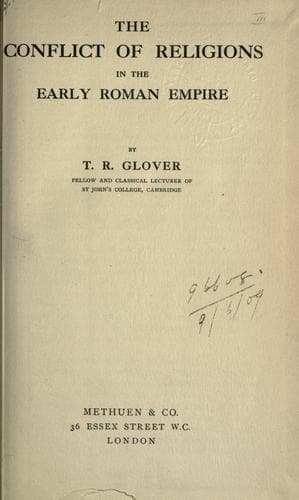
The Conflict of Religions in the Early Roman EmpireGlover, T. R. (Terrot Reaveley)
Religion
The Conflict of Religions in the Early Roman Empire
Glover, T. R. (Terrot Reaveley)
Christianity and other religions; Church history -- Primitive and early church, ca. 30-600; Rome -- Religion
That in later years, in his letters to Lucilius, Seneca should lean to
belief in immortality, is natural enough. Epictetus' language, with
some fluctuations, leans in the other direction: "When God does not
supply what is necessary, he is sounding the signal for retreat--he has
opened the door and says to you, Come! But whither? To nothing
terrible, but whence you came, to the dear and kin [both neuters], the
elements. What in you was fire, shall go to fire, earth to earth,
spirit to spirit [perhaps, breath _hoson pneumation eis pneumation_],
water to water; {70} no Hades, nor Acheron, nor Cocytus, nor
Pyriphlegethon; but all things full of gods and daemons. When a man has
such things to think on, and sees sun and moon and stars, and enjoys
earth and sea, he is not solitary or even helpless."[147] "This is
death, a greater change, not from what now is into what is not, but
into what now is not. Then shall I no longer be? You will be, but
something else, of which now the cosmos has no need. For you began to
be (_egenou_), not when you wished, but when the cosmos had need."[148]
On the whole the Stoic is in his way right, for the desire for
immortality goes with the instincts he rejected--it is nothing without
the affections and human love.[149] But once more logic failed, and
the obscure grave witnesses to man's instinctive rejection of Stoicism,
with its simple inscription _taurobolio in aeternum renatus_.
[Sidenote: The question of the gods]
Lastly we come to the gods themselves, and here a double question meets
us. Neither on the plurality nor the personality of the divine does
Stoicism give a certain note. In the passages already quoted it will
have been noticed how interchangeably "God," "the gods" and "Zeus" have
been used. It is even a question whether "God" is not an identity with
fate, providence, Nature and the Universe.[150] Seneca, as we have
seen, dismisses the theory of daemons or _genii_ rather abruptly--"that
is what some think." Epictetus definitely accepts them, so far as
anything here is definite, and with them, or in them, the ancestral
gods. Seneca, as we have seen, is contemptuous of popular ritual and
superstition. Epictetus inculcates that "as to piety about the gods,
the chief thing is to have right opinions about them," but, he
concludes, "to make libations and to sacrifice according to the custom
of our fathers, purely and not meanly, nor carelessly, nor scantily,
nor above our ability, is a thing which belongs to all to do."[151]
"Why do you," he asks, "act the part of a Jew, when you are a
Greek?"[152] He also accepts the {71} fact of divination.[153]
Indeed, aside perhaps from conspicuous extravagances, the popular
religion suffices. Without enthusiasm and without clear belief, the
Stoic may take part in the ordinary round of the cults. If he did not
believe himself, he pointed out a way to the reflective polytheist by
which he could reconcile his traditional faith with philosophy--the
Public-domain text, read in full here on John Shaqi.
Reviews
Reviews
No reviews yet
Be the first to share your thoughts on this work.
Elsewhere in the archive
Join the Discussion
Join the discussion
Sign in to leave a comment or review.
Sign InorCreate an account