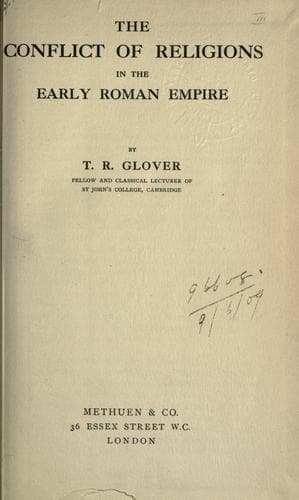
The Conflict of Religions in the Early Roman EmpireGlover, T. R. (Terrot Reaveley)
Religion
The Conflict of Religions in the Early Roman Empire
Glover, T. R. (Terrot Reaveley)
Christianity and other religions; Church history -- Primitive and early church, ca. 30-600; Rome -- Religion
many gods were like ourselves manifestations of the Spermaticos Logos;
and he could accept tolerantly the ordinary theory of daemons, for
Chrysippus even raised the question whether such things as the
disasters that befall good men are due to negligence on the part of
Providence, or to evil daemons in charge of some things.[154] While for
himself the Stoic had the strength of mind to shake off superstition,
the common people, and even the weaker brethren of the Stoic school,
remained saddled with polytheism and all its terrors and follies. Of
this compromise Seneca is guiltless.[155] It was difficult to cut the
connexion with Greek tradition--how difficult, we see in Plutarch's
case. The Stoics, however, fell between two stools, for they had not
enough feeling for the past to satisfy the pious and patriotic, nor the
resolution to be done with it. After all, more help was to be had from
Lucretius than from Epictetus in ridding the mind of the paralysis of
polytheism.
But the same instinct that made men demand immortality for themselves,
a feeling, dim but strong, of the value of personality and of love,
compelled them to seek personality in the divine. Here the Stoic had
to halt, for after all it is a thing beyond the power of reason to
demonstrate, and he could not here allege, as he liked, that the facts
stare one in the face. So, with other thinkers, impressed at once by
the want of evidence, and impelled by the demand for some available
terms, he wavered between a clear statement of his own uncertainty, and
the use of popular names. "Zeus" had long before been adopted by
Cleanthes in his famous hymn, but this was an element of weakness; for
the wall-paintings in every great house gave another account of Zeus,
which belied every attribute with which the Stoics credited him. The
apologists and the Stoics {72} explained the legends by the use of
allegory, but, as Plato says, children cannot distinguish between what
is and what is not allegory--nor did the common people. The finer
religious tempers demanded something firmer and more real than
allegory. They wanted God or Gods, immortal and eternal; and at best
the Stoic gods were to "melt like wax or tin" in their final
conflagration, while Zeus too, into whom they were to be resolved,
would thereby undergo change, and therefore himself also prove
perishable.[156]
"I put myself in the hands of a Stoic," writes Justin Martyr, "and I
stayed a long time with him, but when I got no further in the matter of
God--for he did not know himself and he used to say this knowledge was
not necessary--I left him."[157] Other men did not, like Justin,
pursue their philosophic studies, and when they found that, while the
Stoic's sense of truth would not let him ascribe personality to God,
all round there were definite and authoritative voices which left the
matter in no doubt, they made a quick choice. What authority means to
a man in such a difficulty, we know only too well.
Public-domain text, read in full here on John Shaqi.
Reviews
Reviews
No reviews yet
Be the first to share your thoughts on this work.
Elsewhere in the archive
Join the Discussion
Join the discussion
Sign in to leave a comment or review.
Sign InorCreate an account