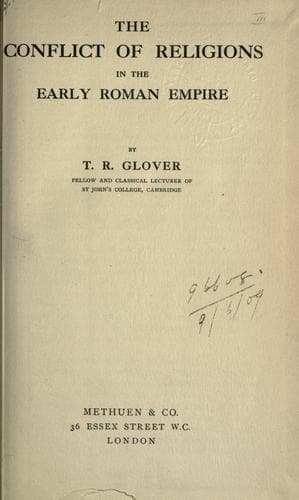
The Conflict of Religions in the Early Roman EmpireGlover, T. R. (Terrot Reaveley)
Religion
The Conflict of Religions in the Early Roman Empire
Glover, T. R. (Terrot Reaveley)
Christianity and other religions; Church history -- Primitive and early church, ca. 30-600; Rome -- Religion
It is easy, but not so profitable as it seems, to find faults in the
religion of other men. Their generation rejected the Stoics, but they
may not have been right. If the Stoics were too hasty in making reason
into a despot to rule over the {74} emotions, their contemporaries were
no less hasty in deciding, on the evidence of emotions and desires,
that there were gods, and these the gods of their fathers, because they
wished for inward peace and could find it nowhere else. The Stoics
were at least more honest with themselves, and though their school
passed away, their memory remained and kept the respect of men who
differed from them, but realized that they had stood for truth.
Chapter II Footnotes:
[1] _Hist._ i, 2.
[2] Tac. _Ann._ iv, 33, _sic converso statu neque alia re Romana quam
si unus imperitet_.
[3] Hdt. iii, 80. Cf. Tac. _A._ vi, 48, 4, _vi dominationis convulsus
et mutatus_.
[4] Suetonius, _Gaius_, 29.
[5] Sen. _de ira_, iii, 15, 3.
[6] Lecky, _European Morals_, i, 275; Epictetus, _D._ iii, 15.
[7] Seneca, _Ep._ 90, 36-43.
[8] Tacitus, _Germany_, cc. 18-20.
[9] Tac. _A._ i, 72. Suetonius (_Tib._ 59) quotes specimens.
[10] See Boissier, _Tacite_, 188 f.; _l'opposition sous les Cesars_,
208-215.
[11] Persius, v, 73, _libertate opus est_.
[12] Horace, _Sat._ ii, 2, 79.
[13] See Edward Caird, _Evolution of Theology in the Greek
Philosophers_, vol. ii, lectures xvii to xx, and Zeller, _Eclectics_,
pp. 235-245. Seneca, _B.V._ 20, 3.
[14] Epictetus, _D._ ii, 8, _su apospasma ei tou theou_.
[15] Lucan, ix, 564-586, contains a short summary of Stoicism, supposed
to be spoken by Cato.
[16] Epictetus, _D._ i, 9 (some lines omitted).
[17] _phantasiai_, impressions left on the mind by things or events.
[18] Epictetus, _D._ i, 9.
[19] Diogenes Laertius, vii, 1, 53; see Caird, _op. cit._ vol. ii, p.
124.
[20] See Lecky, _European Morals_, i, 128, 129.
[21] _Ep._ 108, 22, _philosophiam oderat_.
[22] With these passages compare the fine account which Persius gives
(_Sat._ v) of his early studies with the Stoic Cornutus.
[23] Plutarch, _de esu carnium_, ii, 5.
[24] Plutarch, _de esu carnium_, i, 6, on clogging the soul by eating
flesh. Clem. Alex. _Paed._ ii, 16, says St Matthew lived on seeds, nuts
and vegetables, and without meat.
[25] Plutarch, _de esu carnium_, ii, 1.
[26] Sen. _Ep._ 108, 3, 13-23.
[27] This is a quality that Quintilian notes in his style for praise or
blame. Others (Gellius, _N.A._ xii, 2) found in him _levis et quasi
dicax argutia_.
[28] _Ep._ 78, 2, 3, _patris me indulgentissimi senectus retinuit_.
[29] _Ep._ 58, 5.
[30] _Ep._ 95, 65
[31] His nephew Lucan, Quintilian severely says, was "perhaps a better
model for orators than for poets."
[32] _Ep._ 49, 2. Virgil made one speech.
[33] _ad Polybium_, 13, 2, 3.
[34] Juvenal, x, 16, _magnos Seneca praedivitis hortos_.
[35] _Ann._ xiii, 12, 2.
[36] Tac. _Ann._ xiii, 15-17.
[37] Tac. _Ann._ xiv, 51.
[38] Tac. _Ann._ xiii, 42.
Public-domain text, read in full here on John Shaqi.
Reviews
Reviews
No reviews yet
Be the first to share your thoughts on this work.
Elsewhere in the archive
Join the Discussion
Join the discussion
Sign in to leave a comment or review.
Sign InorCreate an account