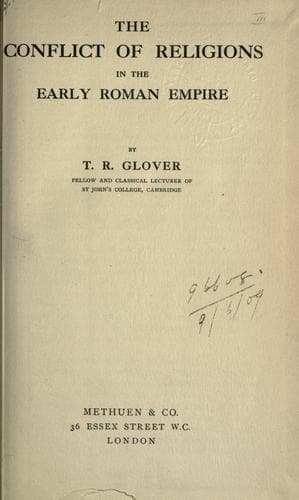
The Conflict of Religions in the Early Roman EmpireGlover, T. R. (Terrot Reaveley)
Religion
The Conflict of Religions in the Early Roman Empire
Glover, T. R. (Terrot Reaveley)
Christianity and other religions; Church history -- Primitive and early church, ca. 30-600; Rome -- Religion
[39] _B.V._ 20, 3.
[40] _B.V._ 23, 1.
[41] Tac. _Ann._ xiv, 52-56.
[42] _de tranqu. animi_, 10, 6.
[43] Tac. _Ann._ xiv, 65; xv, 45-65.
[44] B. W. Henderson, _Nero_, pp. 280-3.
[45] Tac. _Ann._ xv, 65; Juvenal, viii, 212.
[46] Tac. _Ann._ xv, 45, 6.
[47] This is emphasized by Zeller, _Eclectics_, 240, and by Dill,
_Roman Society from Nero to Marcus_, 324, 326.
[48] _ae Clem._ i, 6.
[49] [Transcriber's note: this footnote missing from book]
[50] _Ep._ 61, 1.
[51] Lucian, _Nigrinus_, 19, says there is no better school for virtue,
no truer test of moral strength, than life in the city of Rome.
[52] Gellius, _N.A._ ii, 18, 10.
[53] Gell. _N.A._ xv, 11, 5.
[54] Manual, J. I have constantly used Long's translation, but often
altered it. It is a fine piece of work, well worth the English
reader's study.
[55] _D._ iii, 26. Compare and contrast Tertullian, _de Idol_, 12,
_fides famem nan timet. Scit enim famem non minus sibi contemnendam
propter Deum quam omne mortis genus_. The practical point is the same,
perhaps; the motive, how different!
[56] _D._ iii, 24; iv, 1; _M._ 11, 26.
[57] _D._ ii, 24. He maintains, too, against Epicurus the naturalness
of love for children; once born, we cannot help loving them, _D._ i, 23.
[58] _D._ iv, 1.
[59] _D._ iv, 5, _thelei ta allotrie me einai allotria_.
[60] _D._ i, 18. This does not stop his condemning the adulterer, _D._
ii, 4 (man, he said, is formed for fidelity), 10. Seneca on outward
goods, _ad Marciam_, 10.
[61] _M._ 40.
[62] Fragment, 53.
[63] _D._ i, id.
[64] _D._ iii, 12, classing the _korasidion_ with wine and cake.
[65] _M._ 33.
[66] _D._ iv, 11.
[67] Gell. _N.A._ i, 2, 6; xvii, 19, 1.
[68] Lucian, _adv. Indoct._ 13.
[69] _D._ iii, 9.
[70] _M._ 46.
[71] _D._ iii, 22, _kakorygka_.
[72] _D._ iii, 22. Lucian says Epictetus urged Demonax to take a wife
and leave some one to represent him in posterity. "Very well,
Epictetus," said Demonax, "give me one of your own daughters" (_v.
Demon._ 55).
[73] Epict. _D._ iii, 24. _strateia tis estin ho bios hekastou, kai
aute makra kai toikile. terein se dei to stratiotou prosneuma kai tou
strategou prassein hekasta, ei oion._.
[74] Epict. _D._ iii, 23.
[75] Sen. _Ep._ 112, 3.
[76] _de ira_, iii, 36, 1-4.
[77] Sen. _de tranqu. animi_, 1.
[78] Epict. _D._ iii, 10. I have here slightly altered Mr Long's
rendering.
[79] _D._ iv, 6.
[80] Cf. Persius, iii, 66-72, causas cognoscite rerum, quid sumus aut
quidnam victuri gignimur ... quem te deus esse iussit et humana qua
parte locatus es in re.
[81] D. ii, 11. See Davidson, Stoic Creed, pp. 69, 81, on innate
ideas. Plutarch, _de coh. ira_, 15, on Zeno's doctrine, _to sperma
summigma kai kerasma ton tes phuches dynameon hyparchein apespasmenon_.
[82] The qualification may be illustrated from Cicero's Stoic, _de Nat.
Deor_, ii, 66, 167, _Magna di curant parva neglegunt_.
Public-domain text, read in full here on John Shaqi.
Reviews
Reviews
No reviews yet
Be the first to share your thoughts on this work.
Elsewhere in the archive
Join the Discussion
Join the discussion
Sign in to leave a comment or review.
Sign InorCreate an account