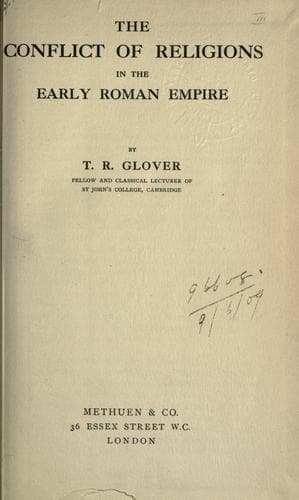
The Conflict of Religions in the Early Roman Empire — John Shaqi
The Conflict of Religions in the Early Roman EmpireGlover, T. R. (Terrot Reaveley)
Religion
The Conflict of Religions in the Early Roman Empire
Glover, T. R. (Terrot Reaveley)
Christianity and other religions; Church history -- Primitive and early church, ca. 30-600; Rome -- Religion
The simple step-dame there will bless
With care the children motherless:
No wife by wealth command procures,
None heeds the sleek adulterer's lures.[11]
Other poets also imagined Golden Ages of quiet ease and idleness, but
the conclusion which Horace drew was more robust. He appealed to the
Emperor for laws, and effective laws, to correct the "unreined license"
of the day, and though his poem declines into declamation of a very
idle kind about "useless gold," as his poems are apt to decline on the
first hint of rhetoric, the practical suggestion was not rhetorical--it
was perhaps the purpose of the piece. In another famous poem, the last
of a sequence of six, all dedicated to the higher life of Rome and all
reaching an elevation not often attained by his odes, he points more
clearly to the decline of religion as the cause of Rome's
misfortunes.[12]
The idea that Rome's Empire was the outcome of her piety was not first
struck out by Horace. Cicero uses it in one of his public speeches
with effect and puts it into the mouth of his Stoic in the work on the
Nature of the Gods.[13] Later on, one after another of the Latin
Apologists for Christianity, from Tertullian[14] to Prudentius, has to
combat the same idea. It was evidently popular, and the appeal to the
ruined shrine and the neglected image touched--or was supposed to
touch--the popular imagination.
Mankind are apt to look twice at the piety of a ruler, and the old
question of Satan comes easily, "Doth Job serve God for naught?" Why
does an Emperor wish to be called "the eldest son of the church?" We
may be fairly sure in the case of Augustus that, if popular sentiment
had been strongly against {8} the restoration of religion, he would
have said less about it. We have to go behind the Emperor and Horace
to discover how the matter really stood between religion and the Roman
people.
Public-domain text, read in full here on John Shaqi.
Reviews
Reviews
No reviews yet
Be the first to share your thoughts on this work.
Join the Discussion
Join the discussion
Sign in to leave a comment or review.
Sign InorCreate an account