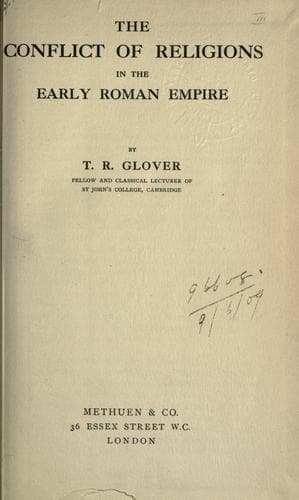
The Conflict of Religions in the Early Roman EmpireGlover, T. R. (Terrot Reaveley)
Religion
The Conflict of Religions in the Early Roman Empire
Glover, T. R. (Terrot Reaveley)
Christianity and other religions; Church history -- Primitive and early church, ca. 30-600; Rome -- Religion
be for centuries, the resort of every one who loved philosophy and
literature.[6] These were the two {79} cities of Greece; the rest were
reminders of what had been. In one of these forsaken places Plutarch
was born, and there he was content to live and die, a citizen and a
magistrate of Chaeronea in Boeotia.
[Sidenote: His family circle]
His family was an old one, long associated with Chaeronea. From
childhood his life was rooted in the past by the most natural and
delightful of all connexions. His great-grandfather, Nicarchus, used
to tell how his fellow-citizens were commandeered to carry wheat on
their own backs down to Anticyra for Antony's fleet--and were quickened
up with the whip as they went; and "then when they had taken one
consignment so, and the second was already done up into loads and
ready, the news came that Antony was defeated, and that saved the city;
for at once Antony's agents and soldiers fled, and they divided the
grain among themselves."[7] The grandfather, Lamprias, lived long and
saw the grandson a grown man. He appears often in Plutarch's _Table
Talk_--a bright old man and a lively talker--like incense, he said, he
was best when warmed up.[8] He thought poorly of the Jews for not
eating pork--a most righteous dish, he said.[9] He had tales of his
own about Antony, picked up long ago from one Philotas, who had been a
medical student in Alexandria and a friend of one of the royal cooks,
and eventually medical attendant to a son of Antony's by Fulvia.[10]
Plutarch's father was a quiet, sensible man, who maintained the
practice of sacrificing,[11] kept good horses,[12] knew his Homer, and
had something of his son's curious interest in odd problems. It is
perhaps an accident that Plutarch never mentions his name, but, though
he often speaks of him, it is always of "my father" or "our
father"--the lifelong and instinctive habit. There were also two
brothers. The witty and amiable Lamprias loved laughter and was an
expert in dancing--a useful man to put things right when the dance went
with more spirit than music.[13] Of Timon we hear less, but Plutarch
sets Timon's goodness of heart among the very best gifts Fortune has
sent him.[14] He emphasizes the bond that brothers have in the family
sacrifices, {80} ancestral rites, the common home and the common
grave.[15] That Plutarch always had friends, men of kindly nature and
intelligence, and some of them eminent, is not surprising. Other human
relationships, to be mentioned hereafter, completed his circle. He was
born, and grew up, and lived, in a network of love and sympathy, the
record of which is in all his books.
Public-domain text, read in full here on John Shaqi.
Reviews
Reviews
No reviews yet
Be the first to share your thoughts on this work.
Elsewhere in the archive
Join the Discussion
Join the discussion
Sign in to leave a comment or review.
Sign InorCreate an account