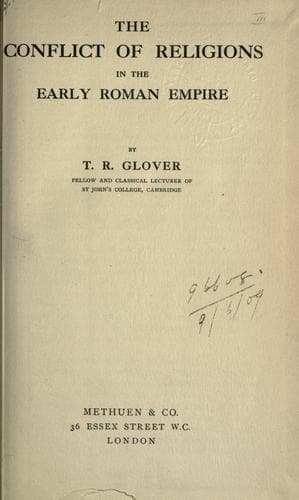
The Conflict of Religions in the Early Roman EmpireGlover, T. R. (Terrot Reaveley)
Religion
The Conflict of Religions in the Early Roman Empire
Glover, T. R. (Terrot Reaveley)
Christianity and other religions; Church history -- Primitive and early church, ca. 30-600; Rome -- Religion
Some such thought is native to every heart, and the man who does not
cling to his own past seems wanting in something essentially human.
The gods were part of the past of the ancient world, and if Reason took
them away, what was left? There was so much, too, that Reason could
not grasp; so much to be learnt in ritual and in mystery that to the
merely thinking mind had no meaning,--that must be received. Reason
was invoked so lightly, and applied so carelessly and harshly, that it
could take no account of the tender things of the heart. Reason
destroyed but did not create, questioned without answering, and left
life without sanction or communion. It was too often a mere affair of
cleverness. It had its use and place, no doubt, in correcting
extravagances of belief, but it was by no means the sole authority in
man's life, and its function was essentially to be the handmaid of
religion. "We must take {78} Reason from philosophy to be our
mystagogue and then in holy reverence consider each several word and
act of worship."[3]
Plutarch is our representative man in this revival of religion, and
some survey of his life and environment will enable us to enter more
fully into his thought, and through him to understand better the
beginnings of a great religious movement, of which students too often
have lost sight.
For centuries the great men of Greek letters were natives of every
region of the eastern Mediterranean except Greece, and Plutarch stands
alone in later literature a Hellen of the motherland--Greek by blood,
birth, home and instinct, proud of his race and his land, of their
history, their art and their literature. When we speak of the
influence of the past, it is well to remember to how great a past this
man looked back, and from what a present. Long years of faction and
war, as he himself says, had depopulated Greece, and the whole land
could hardly furnish now the three thousand hoplites that four
centuries before Megara alone had sent to Plataea. In regions where
oracles of note had been, they were no more; their existence would but
have emphasized the solitude--what good would an oracle be at Tegyra,
or about Ptoum, where in a day's journey you might perhaps come on a
solitary shepherd?[4] It was not only that wars and faction fights had
wasted the life of the Greek people, but with the opening of the far
East by Alexander, and the development of the West under Roman rule,
Commerce had shifted its centres, and the Greeks had left their old
homes for new regions. Still keen on money, philosophy and art, they
thronged Alexandria, Antioch and Rome, and a thousand other cities.
The Petrie papyri have revealed a new feature of this emigration, for
the wills of the settlers often mention the names of their wives, and
these were Greek women and not Egyptian, as the names of their fathers
and homes prove.[5] Julius Caesar had restored Corinth a century after
Mummius destroyed it, and Athens was still as she had been and was to
Public-domain text, read in full here on John Shaqi.
Reviews
Reviews
No reviews yet
Be the first to share your thoughts on this work.
Elsewhere in the archive
Join the Discussion
Join the discussion
Sign in to leave a comment or review.
Sign InorCreate an account