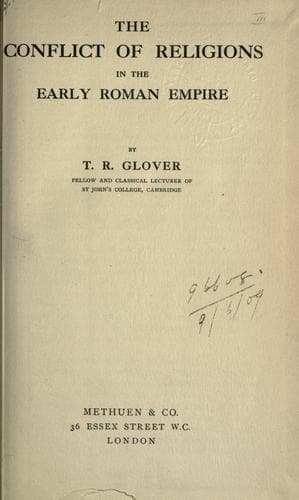
The Conflict of Religions in the Early Roman EmpireGlover, T. R. (Terrot Reaveley)
Religion
The Conflict of Religions in the Early Roman Empire
Glover, T. R. (Terrot Reaveley)
Christianity and other religions; Church history -- Primitive and early church, ca. 30-600; Rome -- Religion
When his student days were over, Plutarch saw something of the world.
He alludes to a visit to Alexandria,[26] but, though he was interested
in Egyptian religion, as we shall see, he does not speak of travels in
the country. He must have known European Greece well, but he had
little knowledge, it seems, of Asia Minor and little interest in it.
He went once on official business for his city to the pro-consul of
Illyricum--and had a useful lesson from his father who told him to say
"We" in his report, though his appointed colleague had failed to go
with him.[27] He twice went to Italy in the reigns of Vespasian and
Domitian, and he seems to have stayed for some time in Rome, making
friends in high places and giving lectures. Of the great Latin writers
of his day he mentions none, nor is he mentioned by them. But he tells
with pride how once Arulenus Rusticus had a letter from Domitian
brought him by a soldier in the middle of one of these lectures and
kept it unopened till the end.[28] The lectures were given in Greek.
He confesses to his friend Sossius Senecio that, owing to the pressure
of political business and the number of people who came about him for
philosophy, when he was in Rome, it was late indeed in life that he
attempted to learn Latin; and when he read Latin, it was the general
sense of a passage that helped him to the meaning of the words. The
niceties of the language he could not attempt, he says, though it would
have been a graceful and pleasant thing for one of more leisure and
fewer years.[29] That this confession is a true one is shown by the
scanty use he makes of Roman books in his biographies, by his want of
acquaintance with Latin literature, poetry and philosophy, and by
blunders in detail noted by his critics. _Sine patris_ is a poor
attempt at Latin grammar for a man of his learning, and in his life of
Lucullus he has turned the streets of Rome into villages through
inattention to the various meanings of _vicus_.[30]
{82}
Public-domain text, read in full here on John Shaqi.
Reviews
Reviews
No reviews yet
Be the first to share your thoughts on this work.
Elsewhere in the archive
Join the Discussion
Join the discussion
Sign in to leave a comment or review.
Sign InorCreate an account