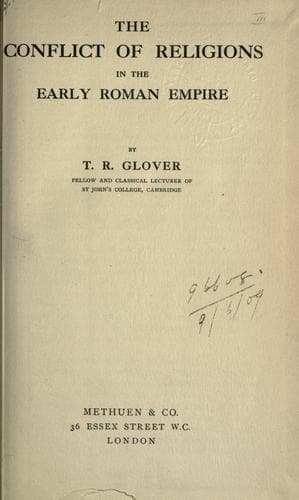
The Conflict of Religions in the Early Roman EmpireGlover, T. R. (Terrot Reaveley)
Religion
The Conflict of Religions in the Early Roman Empire
Glover, T. R. (Terrot Reaveley)
Christianity and other religions; Church history -- Primitive and early church, ca. 30-600; Rome -- Religion
But, as he says, he was a citizen of a small town, and he did not wish
to make it smaller,[31] and he went back to Chaeronea and obscurity. A
city he held to be an organism like a living being,[32] and he never
cared for a man on whom the claims of his city sat loosely--as they did
on the Stoics.[33] The world was full of Greek philosophers and
rhetoricians, lecturing and declaiming, to their great profit and
glory, but Plutarch was content to stay at home, to be magistrate and
priest. If men laughed to see him inspecting the measurement of tiles
and the carrying of cement and stones--"it is not for myself, I say,
that I am doing this but for my native-place."[34] This was when he
was Telearch--an office once held by Epameinondas, as he liked to
remember. Pliny's letters show that this official inspection of
municipal building operations by honest and capable men was terribly
needed. But Plutarch rose to higher dignities, and as Archon Eponymos
he had to preside over feasts and sacrifices.[35] He was also a
Boeotarch. The Roman Empire did not leave much political activity even
to the free cities, but Plutarch loyally accepted the new era as from
God, and found in it many blessings of peace and quiet, and some
opportunities still of serving his city. He held a priesthood at
Delphi, with some charge over the oracle and a stewardship at the
Pythian games. He loved Delphi, and its shrine and antiquities,[36]
and made the temple the scene of some of his best dialogues. "The kind
Apollo (_ho philos_)," he says, "seems to heal the questions of life,
and to resolve them, by the rules he gives to those who ask; but the
questions of thought he himself suggests to the philosophic
temperament, waking in the soul an appetite that will lead it to
truth."[37]
Public-domain text, read in full here on John Shaqi.
Reviews
Reviews
No reviews yet
Be the first to share your thoughts on this work.
Elsewhere in the archive
Join the Discussion
Join the discussion
Sign in to leave a comment or review.
Sign InorCreate an account