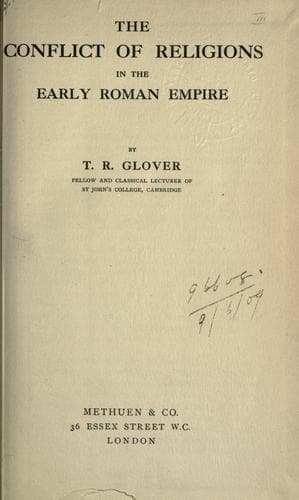
The Conflict of Religions in the Early Roman EmpireGlover, T. R. (Terrot Reaveley)
Religion
The Conflict of Religions in the Early Roman Empire
Glover, T. R. (Terrot Reaveley)
Christianity and other religions; Church history -- Primitive and early church, ca. 30-600; Rome -- Religion
But, after all, it is the characteristic rather than the character that
interests him. He is not among the greatest who have drawn men, for he
lacks the mind and patience to go far below the surface to find the key
to the whole nature. When he has shown us one side of the hero, he
will present another and a very different one, and leave us to
reconcile them if we can. The contradictions remain contradictions,
and he wanders pleasantly on. The Lives of Pericles and Themistocles,
for instance, are little more than mere collectanea from sources widely
discrepant, and often quite worthless. Of the mind of Pericles he had
little {84} conception; he gathered up and pleasantly told what he had
read in books. He had too little of the critical instinct and took
things too easily to weigh what he quoted.
Above all, despite his "political" energy and enthusiasm, it was
impossible, for a Greek of his day to have the political insight that
only comes from life in a living state. How could the Telearch of
Chaeronea under the Roman Empire understand Pericles? Archbishop Trench
contrasts his enthusiasm about the gift of liberty to Greece by
Flamininus with the reflection of Wordsworth that it is a thing
which is not to be given
By all the blended powers of Earth and Heaven.
Plutarch really did not know what liberty is; Wordsworth on the other
hand had taken part in the French Revolution, and watched with keen and
sympathetic eyes the march of events throughout a most living epoch.
It is worth noting that indirectly Plutarch contributed to the
disasters of that epoch, for his _Lycurgus_ had enormous influence with
Rousseau and his followers who took it for history. Here was a man who
made laws and constitutions in his own head and imposed them upon his
fellow-countrymen. So Plutarch wrote and believed, and so read and
believed thinking Frenchmen of the eighteenth century, like himself
subjects of a despotism and without political experience.
Public-domain text, read in full here on John Shaqi.
Reviews
Reviews
No reviews yet
Be the first to share your thoughts on this work.
Elsewhere in the archive
Join the Discussion
Join the discussion
Sign in to leave a comment or review.
Sign InorCreate an account